
AI influencers are computer-generated personas built with 3D modeling, generative image tools, and behavior-analysis algorithms, run by a studio, a brand, or a single operator. The ownership model behind each one predicts how it performs commercially far more reliably than its follower count or render quality does.
Most roundups rank AI influencers by reach or realism. This one doesn't. We sort 17 virtual personas by what actually powers them commercially: who owns the persona, what it sells, and what a brand is really buying when it signs one. AI tool usage nearly tripled between 2020 and 2025, climbing from 116 million to 379 million users, according to Statista. That's why so many marketing teams are suddenly fielding virtual-persona pitches: the tooling expanded faster than the commercial evidence did, and most brands haven't had a framework for separating a real opportunity from a novelty deck.
This piece is that framework. It's built for brand managers and agency leads who need to evaluate a pitch this quarter, not admire a gallery of pretty avatars.
TL;DR
AI influencers are computer-generated personas, and the ones worth studying are the ones where the ownership structure, revenue source, and accountability chain are clear enough to survive a legal and finance review. Here's what the numbers actually show:
- AI influencer campaigns average a 13.7% ROI compared with 12.3% for human influencer campaigns, a modest edge tied to lower production overhead rather than stronger audience connection, per inBeat.
- 36.7% of marketers cite authenticity as their top concern with AI-powered influencers, and 19% specifically worry about triggering consumer distrust, per Influencer Marketing Hub's 2024 AI Marketing Benchmark Report.
- The global influencer marketing industry reached an estimated $32.55 billion in 2025, and separate analysis from Mordor Intelligence puts the broader influencer marketing market at $40.51 billion in 2026, growing toward $152.56 billion by 2031 at a 30.36% CAGR.
- Lil Miquela's 2016 Instagram debut marks the start of the modern virtual persona era, and Shudu Gram's editorial fashion work proved the format could hold a premium placement.
- Ownership structure (agency-owned, brand-owned, or solo-operator) predicts more about a campaign's outcome than follower count does, because the owner controls posting volume, aesthetic consistency, and audience-acquisition spend in ways a human creator's team typically doesn't.
One plain-language takeaway: the fastest-growing part of this space isn't the handful of famous AI influencers getting press coverage. It's the AI influencer generator tools that let anyone spin up a persona in an afternoon, which is also why quality and disclosure practices vary so widely. Virtual influencer market sizing differs substantially across analysts depending on what each firm counts, so treat any single forecast as directional rather than definitive.
Why We Sorted These by Business Model, Not Follower Count
Follower counts on AI influencer accounts are one of the least reliable data points available, because the persona's owner directly controls posting volume, aesthetic consistency, and audience-acquisition spend in ways a human creator cannot. A roundup that ranks by reach is really just measuring how much a studio or operator has chosen to spend on growth.
We applied three questions to every entry instead:
- Who owns the persona, and who profits when it posts?
- What does the persona actually sell: media placements, licensed IP, product, or the generation tooling itself?
- Could a brand realistically buy a campaign with it this quarter, or is it a proof of concept?
Engagement data backs up why this matters more than surface reach. When CreatorIQ analyzed branded content from prominent AI creators, Lil Miquela averaged a 0.6% engagement rate across seven posts for BMW, compared with a 3.6% average across BMW's broader creator community. Imma averaged a 0.3% engagement rate on Coach content against a 4.6% community average. Reach and resonance clearly diverge for most virtual personas, which is exactly why a follower count alone tells a buyer very little about whether an audience is actually connecting with the content.
That analysis found one documented exception: Aitana López's engagement rates on Olaplex (8.9%), Victoria's Secret (6.5%), and Balenciaga (4.9%) exceeded her community's averages, a pattern CreatorIQ attributes to her hyper-realistic aesthetic rather than to an established audience relationship. We'll come back to her.
The three categories below aren't organized by platform or region. They're organized by who owns the persona and how it generates revenue.
| Framework Dimension | Studio-Built Icons | Brand-Owned Avatars | Solo-Operator Personas |
| Who owns the persona | Creative studio, CGI house, or dedicated agency | The brand or its retained agency | An individual or small team |
| Primary revenue source | Brand deals and IP licensing | None directly; supports owned media and product sales | Sponsorships, affiliate links, and increasingly, tooling or course sales |
| Buyable this quarter | Yes, through agency contracting | Not applicable; brands build rather than buy | Sometimes, usually through direct outreach |
| Typical brand fit | Fashion, luxury, beauty, automotive, entertainment | Retail, QSR, telecom, financial services, marketplaces | Niche categories, DTC, gaming, regional communities |
| Governance burden | Sits with the studio, contractually shared | Entirely internal; approval layers must exist | Largely unmanaged, which is the main buyer risk |
A caveat worth stating plainly: some personas sit near a category boundary. We placed them according to their primary revenue source, not their platform or aesthetic. And a second caveat on data quality: follower and engagement figures on these accounts are self-reported through platform surfaces and shift constantly, so we describe positioning and business model here rather than publishing volatile counts as settled fact.
Studio-Built Icons: The Personas That Wrote the Playbook
These are personas built and run by a creative studio, CGI house, or dedicated agency, with a full team behind narrative, art direction, and brand partnerships. What a brand buys here is a controlled, contract-backed placement with predictable output and an existing audience. What it gives up is cost, slower turnaround, and none of the organic surprise a human creator brings.
The category's production history compresses into a familiar arc: early-2010s CGI mascots gave way to real-time sentiment analysis by around 2020, and by 2022 studios were running virtual concerts and interactive livestreams. Six entries define the category below, including one that shows what happens when the governance layer fails.
Lil Miquela
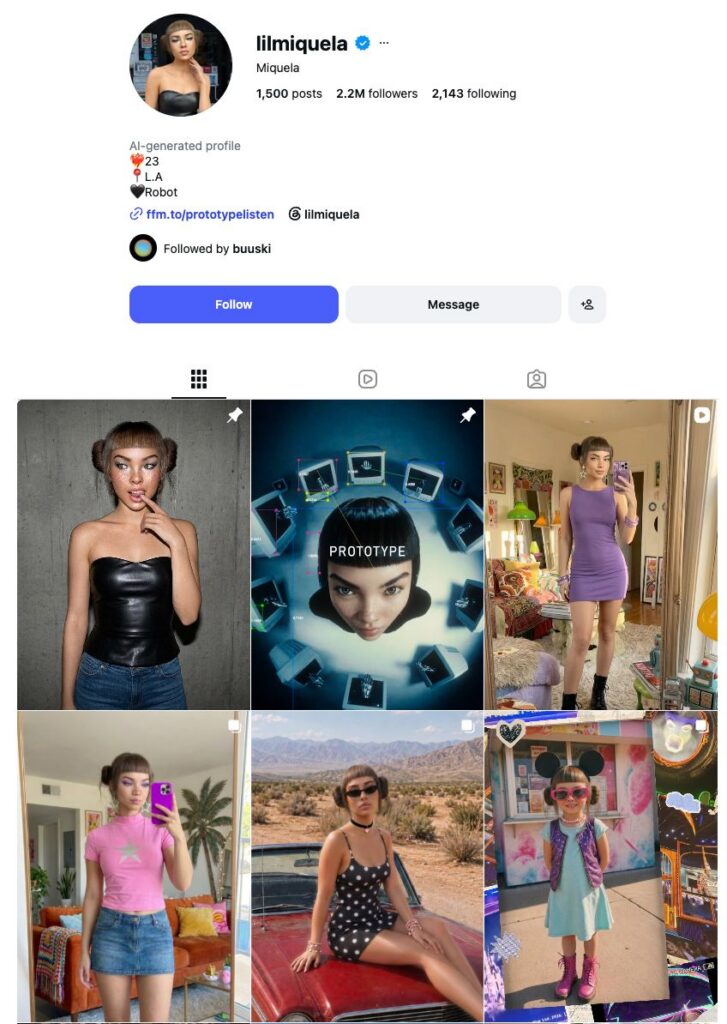
Lil Miquela debuted on Instagram in 2016, and that date is the commonly cited starting point for the modern virtual-influencer category. She's a studio-owned persona built around a fully written backstory, music releases, and fashion partnerships with brands including Calvin Klein and Samsung.
Her decade of relevance is the actual lesson here: it comes from continuous narrative investment, not from render quality. A persona decays without a writers' room behind it. Her specific deal economics aren't publicly verifiable, so any rate card circulating online should be treated as unconfirmed.
Shudu Gram
Shudu Gram is a hyper-realistic digital model created by photographer Cameron-James Wilson, and her work has appeared in fashion editorial content that gave the format early credibility with luxury and beauty brands. The model here is a photographer-founded digital modeling studio generating revenue from campaign and editorial work, and the buyer is often a creative director rather than a performance marketer.
There's an unresolved ethical debate that follows Shudu specifically: questions about who creates and profits from a persona representing an identity and community the creator doesn't belong to. That's a live discussion in the industry, not a settled verdict, and it's worth understanding before signing a similarly positioned persona.
Noonoouri
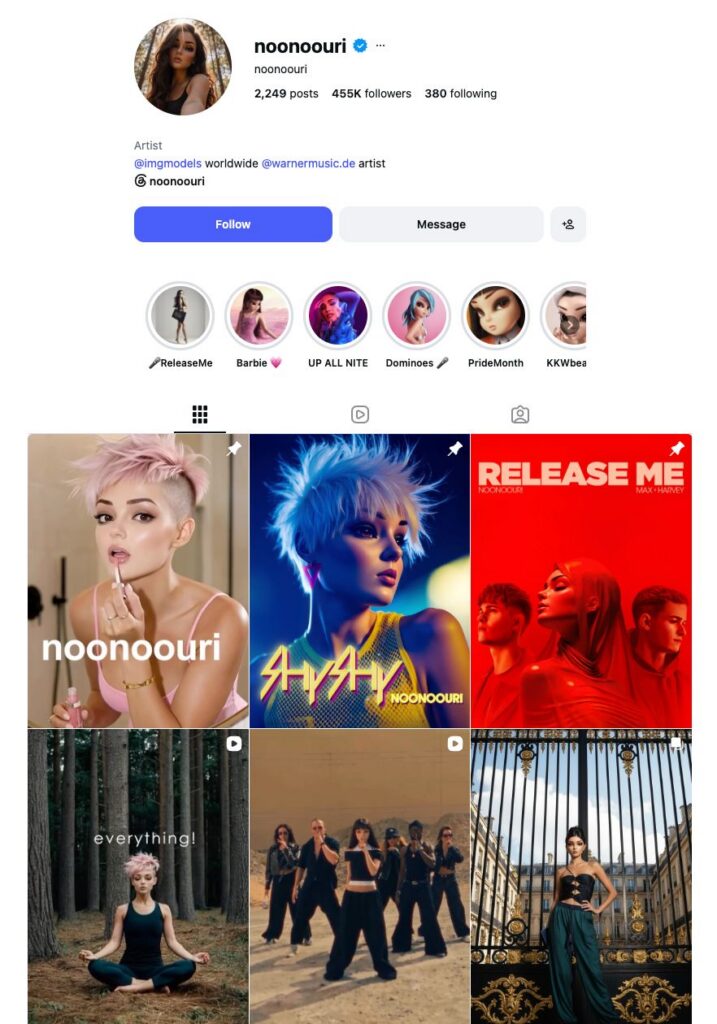
Worth a direct correction here, because it matters for accuracy: Noonoouri is frequently mislabeled as an AI influencer, but her creator, artist Joerg Zuber, has stated the character's design, styling, and movement are entirely human-crafted CGI, not AI-generated. Noonoouri herself has pushed back publicly on the mislabeling. We're including her because the stylized, deliberately non-photorealistic, doll-like aesthetic she pioneered is the design pattern many AI-generated personas later borrowed, and because Warner Music's 2023 recording deal with her showed a virtual persona could cross into music, not just fashion.
The design lesson holds regardless of whether the underlying production is AI or human-crafted CGI: stylization sidesteps the uncanny-valley trust penalty because nobody mistakes the character for a real person. Disclosure is effectively baked into the aesthetic itself.
Imma
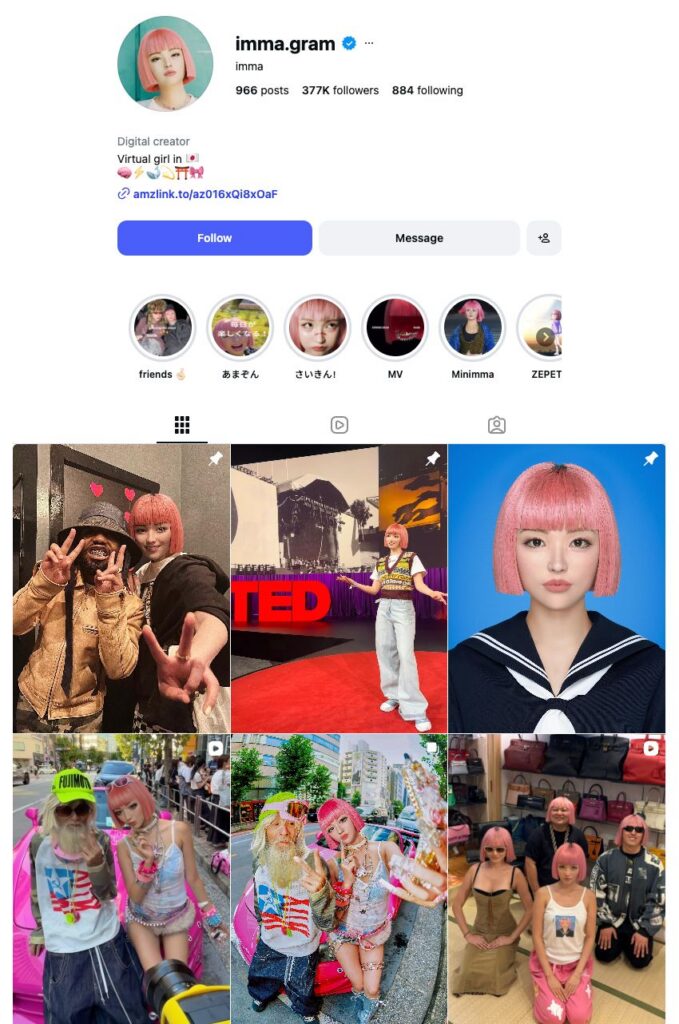
Imma is a Tokyo-based, studio-produced persona known for photoreal composites placed into real environments. She's managed by Aww, Inc., which builds ongoing storylines for her and other virtual humans, according to ABC News reporting from May 2025. Her brand collaborations span Porsche, BMW, SK-II, and Amazon Fashion, and her Coach partnership included an experimental AI chat feature at a Japan pop-up where she offered shoppers style advice, plus an in-store LED display staged with real furniture to extend the persona beyond the feed.
The lesson: regional cultural fluency is a moat. A persona built for one market rarely ports cleanly to another, and casting a virtual persona across markets requires the same localization discipline as casting a human, often more.
Rozy
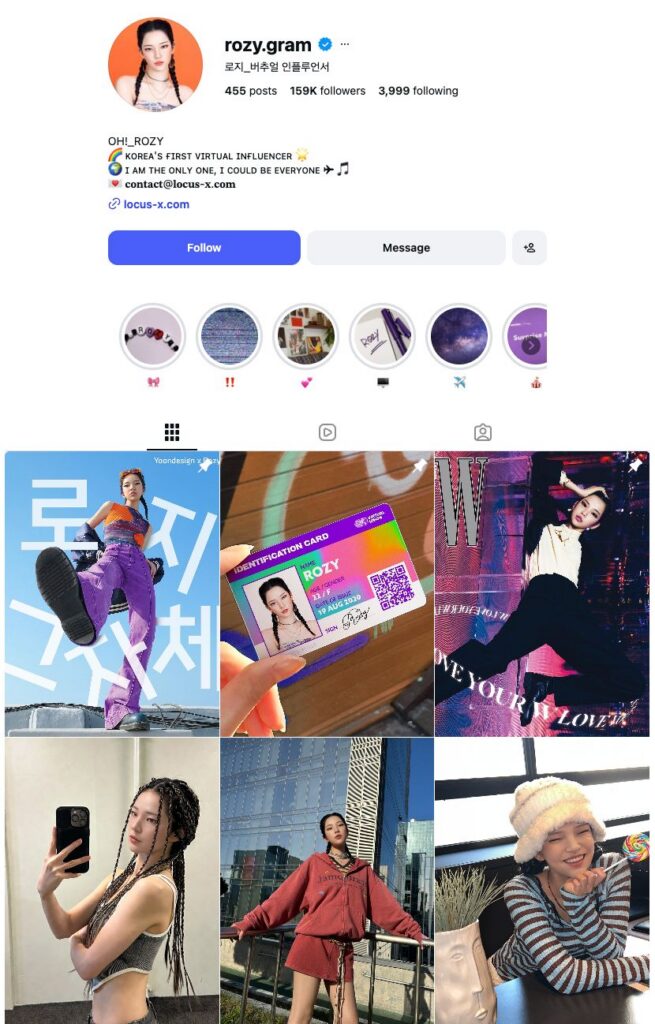
Rozy is a studio-managed Korean virtual persona created by Sidus Studio X, first appearing on Instagram in August 2020. She's landed more than 100 brand sponsorships according to Korea.net and outlets including Today Online, spanning insurance, automotive, and hospitality categories. That endorsement volume is closer to a traditional talent-agency roster slot than to a typical creator partnership.
The lesson: in markets with strong celebrity-endorsement norms, virtual talent slots into an existing commercial structure rather than inventing a new one. Specific deal counts vary across press coverage, so treat the pattern as directional rather than as a precise figure.
FN Meka: The Category's Cautionary Entry
Not every studio-built persona succeeds, and one failure is instructive enough to include here. FN Meka was an AI-assisted virtual rapper signed to Capitol Records in August 2022. Within ten days, Capitol dropped the project after backlash over the persona's use of racial stereotypes, including a slur in a track and imagery depicting the character assaulted by police. Capitol's public statement acknowledged signing the project "without asking enough questions about equity and the creative process behind it."
The failure point was governance, not the underlying technology. No approval layer caught the cultural risk before the contract was announced. It's worth asking directly: who on your team signs off on a synthetic persona's cultural positioning before it posts?
Brand-Owned Avatars: When the Company Is Also the Talent
This category is defined by the brand owning the persona outright, created and operated in-house or through a retained agency, rather than renting access to someone else's audience. What the brand buys is total creative control, permanent IP, and no third-party talent-scandal risk. What it gives up is a cold start: the persona begins with zero audience, and building one is absorbed as media spend rather than paid out as a talent fee. Five entries and archetypes follow.
Kuki
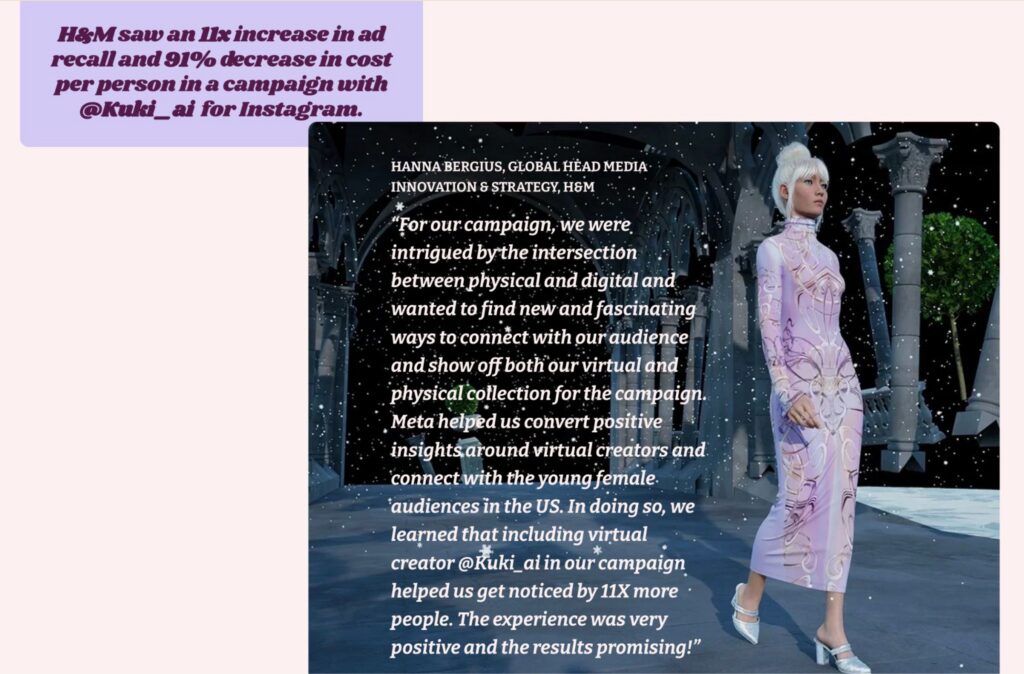
Kuki began as a chatbot and later migrated into social and brand activation work, with a model built on conversational engagement, gaming integrations, and licensing. The relevant KPI here isn't reach, it's interaction depth: conversation length and return rate matter more than impressions. The trade-off is moderation liability. Every unscripted reply the persona generates is effectively a brand statement, which means conversational personas need a review process that photo-based personas don't.
Nobody Sausage
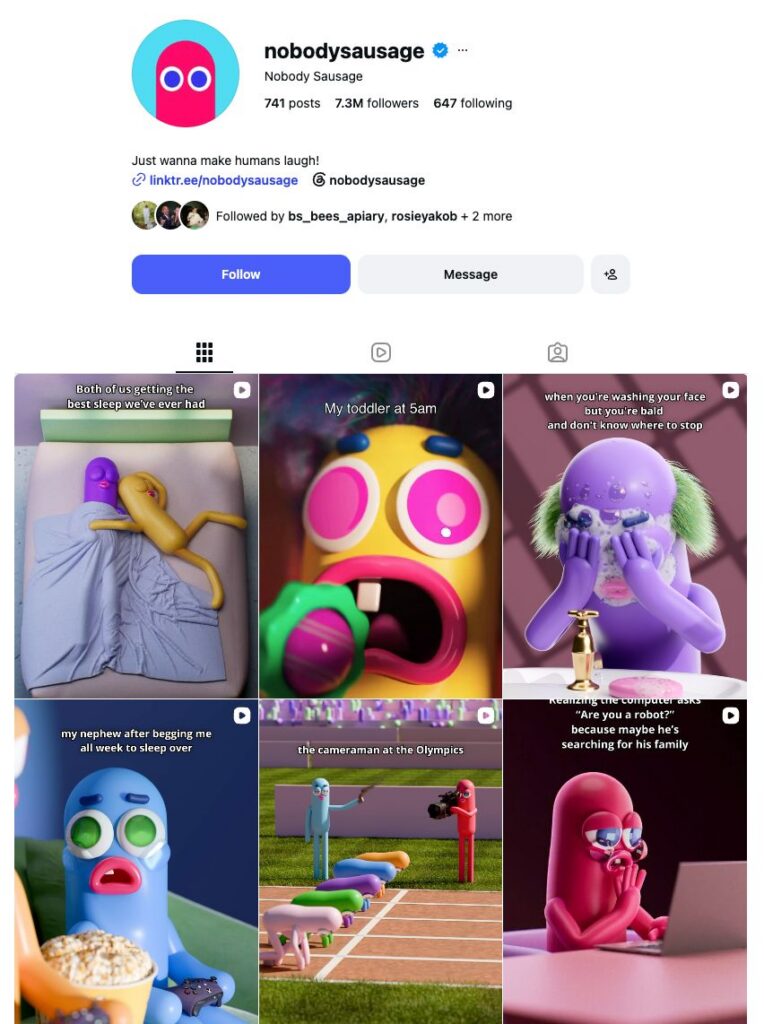
Nobody Sausage is an animated character built specifically for looping short-form video rather than photoreal stills, with brand integrations layered on top of platform-native reach. The lesson generalizes well beyond this one account: format determines persona design. A persona engineered for the still-image feed tends to underperform when ported to short-form video, and the reverse holds too. Short-form platforms reward character consistency and repeatable visual gags over realism, which is a different design brief than most studio-built icons follow.
Explainer Avatars in Fintech and Telecom
A recognizable pattern in regulated industries: brands deploy owned avatars to deliver product explanation at scale, often across multiple languages, for finance, telecom, and insurance products. The model is fully owned, low-glamour, and high-utility, measured in support-deflection and comprehension rather than likes. The most underdiscussed application of AI-generated personas is internal and educational rather than reach-driven. Marketing gets the coverage; operations gets the savings.
Retail-Media House Avatars
The newest brand-owned pattern: retailers and marketplaces spinning up owned personas to model, demo, and merchandise catalog products at a volume no human photo shoot schedule can support. The ROI case here is production-cost avoidance rather than audience monetization, connecting to the up-to-30% cost savings framing SPIRRA has published in prior analysis of AI influencers and virtual ambassadors. Cost-saving figures are directional and vary by category and production baseline. One thing brands frequently overlook: the models, photographers, and stylists whose past work informs or trains the persona need contractual clarity on rights, not just the persona's own likeness.
Solo-Operator Personas: The Quiet Economy Nobody Puts in Roundups
This is the category most trade coverage skips entirely: individuals or small teams running one or more AI personas as a revenue business, using an AI influencer generator, trained image models, and scheduling tools. What they sell spans affiliate revenue, subscription content, sponsorships from smaller advertisers, and increasingly, the tooling and courses that teach others how to do it.
Roundups skip this category for a structural reason: operators rarely publish real numbers, many work pseudonymously, and the community discussion happens on forums rather than in trade press. Threads discussing AI influencers on Reddit are one of the few places operators talk about unit economics openly, but those claims are self-reported and unverifiable. Treat that kind of forum discussion as directional signal, never as audited evidence. If you're benchmarking against this category, the lack of clean data is genuinely frustrating, and that frustration is a fair reaction, not a sign you're missing something obvious.
Aitana López
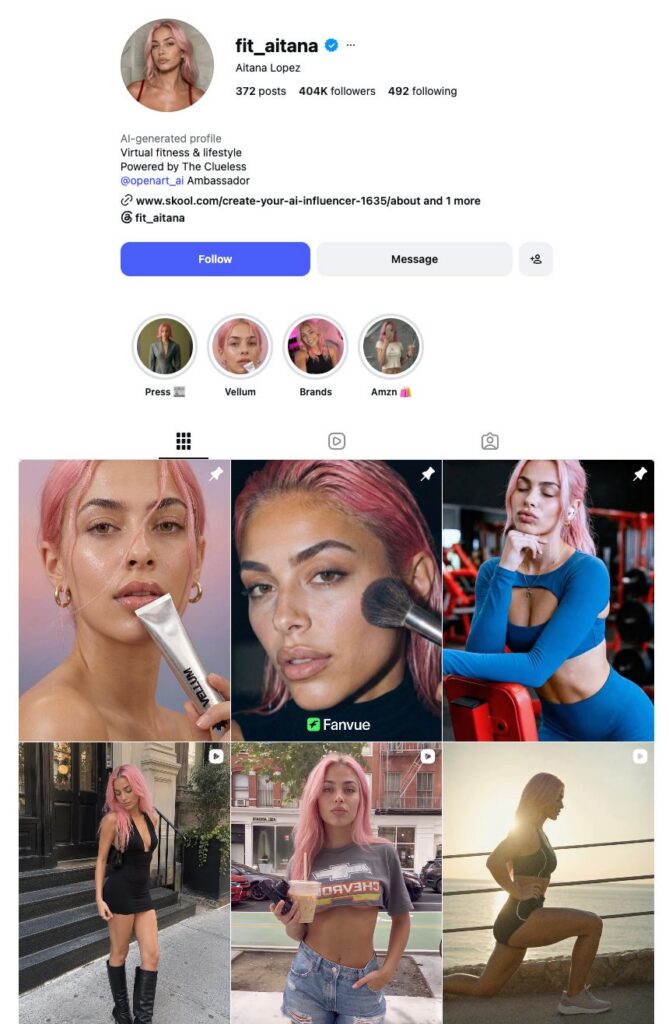
Aitana López is a Spanish agency-created persona built by Barcelona-based studio The Clueless, positioned as a fitness and lifestyle figure since mid-2023. She's widely cited as an early example of a small team monetizing a synthetic persona through brand placements, with a model closer to sponsorship plus subscription-adjacent revenue than a full studio production. The operating cost here resembles a content calendar more than a production budget, which is exactly what changes who can realistically compete in this category.
As noted above, she's the documented exception to the engagement gap affecting most virtual personas: her rates for Olaplex, Victoria's Secret, and Balenciaga campaigns beat community averages, per CreatorIQ, with visual realism cited as the likely driver rather than an established audience relationship. Reported monthly earnings figures for Aitana circulate widely across outlets and vary substantially; treat any specific number you see as unconfirmed.
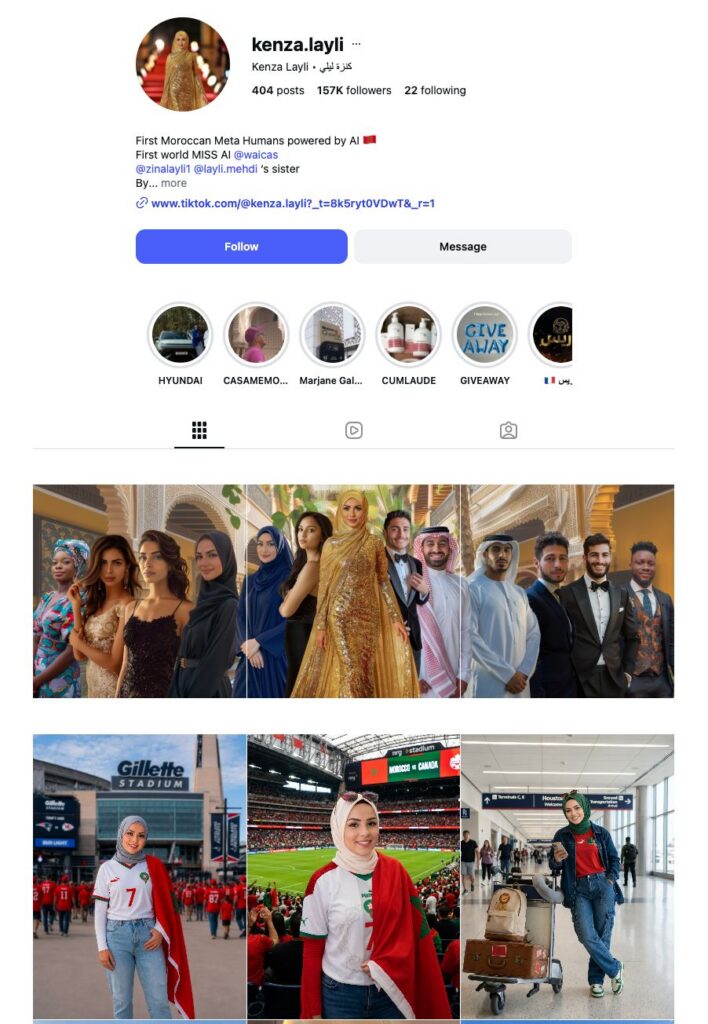
Kenza Layli
Kenza Layli built distribution through AI-focused recognition competitions, converting a win into brand conversations and platform growth. For a persona with no existing audience and no studio budget, a manufactured recognition moment is one of the cheapest distribution events available, and virtual personas can enter far more of these cycles simultaneously than a human creator typically could. Kenza's positioning is built around North African and Arab identity, which the operator has described as deliberate representation; that's the operator's stated intent, not an outcome that can be independently verified. Worth flagging: recognition programs in this space are young, and their selection standards aren't standardized, so a win should be read as a marketing asset rather than a quality certification.
The Tooling-Seller Archetype
A widespread pattern rather than a single named operator: someone builds a persona, grows it modestly, then monetizes primarily by selling the workflow behind it, a course, a template pack, a Discord community, or a white-labeled generator subscription, to aspiring operators. Often the persona's own sponsorship income is smaller than the income from teaching others to build one.
If you're evaluating a solo persona for a partnership, ask what percentage of its revenue comes from advertisers versus from an audience of would-be operators. An audience of aspiring builders converts poorly for a consumer brand, so the real question is whether you're buying access to customers or access to people who want your seat. This is a structural observation about a common pattern, not an accusation against any specific operator.
The Affiliate-Arbitrage Operator
Another pattern rather than a single account: high-volume persona accounts built to route traffic toward affiliate offers, subscription platforms, or link aggregators. Aesthetic sameness across these accounts is a feature, not an accident, since operators reuse whatever prompt and model settings convert best. Cost per persona is close to zero, so operators run portfolios and cull whatever underperforms.
This is why follower counts on these accounts are such an unreliable quality signal; audience acquisition is frequently paid or engagement-farmed. It also creates real brand-safety exposure: a placement can land beside content the brand never approved, because the operator can change monetization strategy without notice. Not every high-volume operator here is acting in bad faith; many are simply testing at a speed traditional creators can't match.
The Niche-Community Persona
The most practically applicable pattern for a brand with a modest budget: personas built around a narrow interest, a specific game, hobby, regional dialect, sport, or subculture, where the operator has genuine domain knowledge. The audience is small, trust is high, and revenue comes from direct product sales or a handful of category-relevant sponsorships. The generation tool is a commodity here; the operator's knowledge of the community is not, and that's the durable input worth paying for.
One caveat that cuts the other way from what you might expect: disclosure matters more in tight communities, not less. Niche audiences detect and punish undisclosed synthetic accounts faster than general audiences do.
The Platform-Native Generator Persona
The fastest-growing entry point into this category: an operator uses one end-to-end generation tool for character consistency, image generation, captioning, and scheduling, without a separate editing pipeline. This is where demand for free, all-in-one generator tools concentrates, and it explains why output across these accounts often looks visually similar.
The hidden cost is platform lock-in. Character consistency is usually tied to a model checkpoint the operator doesn't own or control, so a platform policy change can end a persona overnight. Operators who want durability train and retain their own character model rather than renting one. Tool-capability claims move fast in this space, so evaluate any generator on export rights and model portability rather than on a feature checklist, which will be outdated within a quarter.
Building One Yourself: What Generator Tools Do and Don't Solve
A large share of readers researching this topic want to build a persona, not partner with one. Here's the honest framing: an AI influencer generator solves the image problem, and the image problem was never the hard part. Persona consistency, narrative, disclosure, and distribution are the parts that actually determine whether a persona becomes a functioning program or a good-looking test render that never ships.
A practical sequence for building one:
- Define the persona's purpose and audience before any visual work. What does it sell, and to whom?
- Lock character consistency with a trained character model or a disciplined reference set, so the face and body hold across hundreds of outputs.
- Build the voice: caption tone, recurring formats, and a small set of narrative through-lines.
- Decide the disclosure standard and write it into the bio and every paid post before launch, not after.
- Set a review checkpoint: who approves cultural positioning, product claims, and any conversational output?
- Pilot small, measure sentiment alongside engagement, and iterate.
On tool selection, feature checklists age quickly. What actually separates a strong generator from an average one comes down to three things: character consistency across poses and lighting, export rights, and whether you can move your trained character model off the platform if you need to.
A free tier is fine for testing a concept and poor for running an actual business, since output resolution, commercial-use rights, and consistency controls are usually the features that get gated behind a paid plan. A "good enough to validate" free tool is not the same thing as "good enough to ship."
| Evaluation Criterion | What to Verify Before Committing | Why It Decides the Outcome |
| Character consistency | Same face and body across poses, lighting, and camera distance, tested across at least 50 outputs | Inconsistency is the single most common reason a persona reads as fake to an audience |
| Model portability | Whether you can export or retain the trained character model outside the platform | A pricing or policy change on a rented checkpoint can end the persona overnight |
| Commercial-use rights | Written terms covering paid advertising, resale, and client work at your intended tier | Free and starter tiers frequently exclude the exact use case a business needs |
| Output resolution and format | Maximum resolution, aspect ratios, and video support on your actual plan | Gated resolution turns a promising test into unusable campaign assets |
| Disclosure and metadata support | Whether generation metadata or content credentials survive export | Documentation of how content was generated is what compliance teams ask for |
| Workflow and approval controls | Multi-user access, version history, and prompt documentation | Scaling past one persona becomes a governance problem, not a generation problem |
Teams that scale past a single persona end up operating something closer to a small production studio in practice, with asset libraries, prompt documentation, approval workflows, and a real content calendar. The generation tool ends up being the smallest line item in that operation. Choosing that setup should be decided on portability and approval controls, not on the length of a feature list.
One more consideration for brands weighing photorealism specifically: the more realistic a persona looks, the higher the trust cost if disclosure is unclear, since photoreal personas invite the strongest backlash when audiences later learn a persona wasn't real. And a category worth naming directly: brands whose category depends on demonstrated personal experience, health, financial advice, parenting, or food, generally get less value from a synthetic persona than from verified human creators, because the credibility those categories require comes from lived experience a synthetic persona can't claim.
The Diligence Questions Brands Skip Before Signing a Virtual Persona
The FN Meka failure established that the risks in this category are procedural, not technological. Building on that, here's a governance framework worth working through before signing anything.
- Who legally owns the persona's likeness, name, and generated output, and what happens to campaign assets when the contract ends?
- What human input exists in the creative chain? Most jurisdictions require substantive human authorship for copyright protection, so a fully automated pipeline can create real ownership gaps.
- How is the persona disclosed, and does the disclosure language satisfy FTC requirements for paid and sponsored content in the US?
- Were any real people's likenesses, voices, or photographs used as source material, and are those permissions documented?
- Who moderates and approves anything the persona says in comments or DMs?
- How is audience quality verified, and can the operator show anything beyond a platform-surface follower count?
| Diligence Question | Why It Matters | Red Flag Answer |
| Who owns the persona's likeness, name, and generated output? | Determines whether campaign assets survive the end of the contract | "We'll sort that out in the SOW" |
| What human input exists in the creative chain? | Most jurisdictions require substantive human authorship for copyright protection | "It's fully automated end to end" |
| How is the persona disclosed on paid content? | FTC rules apply to synthetic endorsements the same as human ones | "Our audience already knows" |
| Were real people's likenesses, voices, or photos used as source material? | Unpermissioned source material creates likeness and privacy exposure | "We're not sure what the model was trained on" |
| Who moderates comments, DMs, and any conversational output? | Every unscripted reply is a brand statement | "The persona handles that on its own" |
| How is audience quality verified beyond follower counts? | Platform-surface numbers are the metric the operator controls most easily | "Here's a screenshot of the follower graph" |
The regulatory picture here is genuinely uneven, and it's worth stating plainly rather than glossing over. As of September 2026, the UK's Advertising Standards Authority has confirmed there is nothing in its current rules that explicitly prohibits brands from posting AI-generated promotional content without disclosing it, provided the content itself isn't misleading, according to The Guardian's June 2026 investigation. The EU's Artificial Intelligence Act, by contrast, began applying transparency requirements for AI-generated and manipulated content in August 2026, meaning a campaign that's compliant in one market may carry no disclosure obligation at all in another. That same investigation found some creators producing AI-generated content for brands were asked to sign non-disclosure agreements preventing them from discussing the work, with one source estimating that a substantial share of some major brands' social content is already AI-generated.
The practical implication connects back to the trust concern raised earlier: disclosure isn't just a legal checkbox, it's a performance variable, because audiences react very differently to a persona they knew was synthetic from the start versus one they discover was synthetic later. The most common structure among brands reporting durable results is a hybrid one: pairing a virtual persona with verified human creators, which preserves scale while keeping emotional credibility in the mix. If your team is being asked to move fast on this because leadership saw one impressive render, this diligence list is what protects the decision from being made on vibes alone.
Will AI Replace Human Creators, or Just Reprice Them?
No, but it repositions where human creators command a premium. That's the honest answer, and it's worth resisting the urge to make it sound more dramatic than the evidence supports.
Synthetic personas win on production volume, catalog and product imagery, multilingual explanation, always-on presence, and categories where the audience is primarily buying aesthetics rather than judgment. Human creators win on lived experience, credibility in high-consequence categories, community relationships built over time, crisis response, and anything requiring accountability an audience can attach to an actual person.
The size gap between the two segments remains substantial. The global influencer marketing industry reached an estimated $32.55 billion in 2025, per Influencer Marketing Hub, while Mordor Intelligence projects the broader market to grow from $40.51 billion in 2026 to $152.56 billion by 2031. The virtual segment is a real and growing slice of that market, but it isn't close to overtaking the human-creator economy it's often framed as competing against.
A question worth addressing directly: how many AI influencers are there? There's no reliable census, because the definition ranges from a six-figure studio production to an account someone generated last Tuesday. Any specific number circulating in a deck or article should be read as an estimate of a moving target, not a settled count.
Real people still shape, monitor, and refine synthetic output in every functioning program we've described in this piece, and the categories where that human oversight is thinnest, like FN Meka's, are exactly where the failures cluster. That's consistent with SPIRRA's own position: AI belongs in the measurement and matching layer of influencer marketing more than in the talent layer, because that's where it removes guesswork without removing accountability from the process. Budget allocation between human and synthetic talent should depend on category and use case, not on ideology about where the industry is headed.
Frequently Asked Questions
Which AI influencers on Instagram are actually worth following for research?
Follow a deliberate spread rather than a leaderboard. Pick two studio-built personas, two brand-owned campaign accounts, and two solo-operator accounts, then watch how often each posts, how they disclose their nature, and what they're actually selling. Studio accounts show you the production ceiling for the category. Brand accounts show you what a legal and compliance team will actually approve. Solo accounts tend to show where tactics are heading next, often months before trade press covers them.
Save posts by format rather than by account, since the reusable insight lives in the format, not the specific persona. Any "top AI influencers" list you find is likely ranked by follower count, which this piece has already shown to be a weak signal on its own; treat those lists as a discovery starting point, not a shortlist. Lil Miquela's Instagram account remains the single most-studied reference point for anyone starting this research.
How do people actually make money with AI influencers?
Four channels dominate, in roughly descending order of reliability: brand sponsorships, affiliate and performance links, subscription or gated content, and selling the workflow itself to other operators. For many small operators, that fourth channel, courses, templates, or tooling subscriptions, frequently outearns the first three combined.
The real cost side includes generation tooling, paid distribution, and the time spent on consistency and moderation. Revenue net of paid reach is the only number worth tracking. Earnings claims circulating in this space are almost entirely self-reported and rarely audited, so screenshots of income should be treated as marketing material, not evidence.
Do audiences actually trust AI influencers?
Trust depends less on how realistic a persona looks and more on when disclosure happens. Audiences generally forgive a persona they knew was synthetic from the first post. They react far more negatively to discovering it later. That's marketer-side sentiment speaking, not measured consumer behavior: 36.7% of marketers cite authenticity as their top concern with AI-powered influencers, and 19% specifically worry about triggering consumer distrust, per Influencer Marketing Hub. Reliable consumer-side trust data in this category is still thin, so that figure is a useful proxy, not proof of how audiences actually behave.
The regulatory gap widens the risk here. The Guardian's 2026 investigation found brands quietly deploying AI-generated personas in content that appears to show genuine customer experiences, with the UK's ASA confirming its rules don't currently prohibit undisclosed AI-generated promotional content. Segment-test before scaling any synthetic-persona campaign, since tolerance for disclosure timing varies sharply by category and age cohort.
Is the ROI on AI influencer campaigns better than on human campaigns?
The benchmarks show a modest edge, not a step change. AI influencer campaigns average a 13.7% ROI compared with 12.3% for human influencer campaigns, per inBeat. A 1.4-point spread is a production-efficiency story, not an audience-quality story; the gain comes from lower overhead, no travel or crew costs, and faster content cycles, not from a synthetic persona connecting better with an audience.
Aggregate ROI benchmarks like this one flatten enormous variance across categories, and campaign-level attribution in influencer marketing remains inconsistent across platforms. Use this benchmark to justify running a test, not to justify reallocating an existing human-creator budget.
Where the Verification Problem Gets Expensive
Every diligence question this piece has raised comes down to one unresolved problem: how do you verify audience quality, on a synthetic or a human account, when follower counts are the only metric available on the public surface of most platforms?
This is the specific gap SPIRRA was built to close. The platform runs on a 100% verified influencer network across roughly 19 million in-network and out-of-network influencers, with True Follower™ metrics that verify audience authenticity, and Audience Alignment Score™, Brand Alignment Score™, and Content Alignment Score™ ratings that quantify fit instead of relying on a follower graph screenshot. A discovery engine analyzing over 200 data points, paired with the CoraIQ™ optimization agent inside SPIRRA's Alignment Analysis Suite, backs automated brand safety compliance monitoring and fraud detection across the network.
That positioning is deliberate: SPIRRA's AI sits in the discovery and verification layer of influencer marketing, not in the talent layer, so accountability stays with real creators while the guesswork leaves the process. If your team is running AI influencer marketing programs, human, synthetic, or both, and needs a way to verify who you're actually working with, book a SPIRRA demo to see how the verification layer works in practice.
Final Thoughts
Before evaluating any AI persona, ask three questions: who owns it, what does it actually sell, and who is accountable when it says something wrong. Those three answers predict the outcome of a partnership far more reliably than render quality ever will.
Most marketing teams are being asked to have a point of view on this before they've had time to build a real strategy, and that pressure is exactly where weak commitments get made. The category is real, the tooling is improving faster than the governance built around it, and the brands doing this well are the ones treating synthetic personas as a production capability, not as a talent replacement. The interesting shift over the next cycle probably isn't better-looking personas. It's clearer standards for disclosing them, and the brands that get ahead of that standard, rather than waiting for regulators to force it, are the ones that will avoid the FN Meka outcome instead of studying it as a cautionary tale.