
Most beauty influencer lists rank creators by reach or aesthetic appeal. This one doesn't. We're focused on beauty influencers who teach frameworks you can apply on your own, not just looks to admire, because that's the difference between watching a tutorial and actually building a skill.
TL;DR
- We focused on beauty influencers who provide teachable frameworks, not just product reviews or aspirational aesthetics.
- Technical application experts decode professional techniques into repeatable steps that work across different face shapes, eye types, and skill levels.
- Inclusive framework builders address gaps in mainstream beauty education by centering darker skin tones, gender-expansive perspectives, and underrepresented beauty standards.
- Product science communicators translate ingredient research, dermatology principles, and cosmetic chemistry into practical purchasing and routine decisions.
- The most valuable top beauty influencers create educational systems that remain useful after the initial watch, turning entertainment into durable skill development.
Introduction
Most beauty influencer lists celebrate reach, aesthetics, or entertainment value. We're taking a different approach by focusing on educational transfer and framework building. The beauty influencers here teach systems you can apply independently, not just looks to admire.
Three distinct categories organize this list based on what each creator actually teaches: technical application, inclusive frameworks, and product science. Each brings a specific instructional style that builds competency rather than dependency. You'll find these influencers beauty across Instagram, YouTube, and TikTok, and platform diversity matters here because different formats suit different learning styles. These creators have built audiences by solving specific problems that mainstream beauty content often overlooks.
Influencer recommendations clearly shape beauty purchasing behavior. A 2023 study from beauty industry publication BeautyMatter found that 49% of Gen Z and millennial consumers had purchased a product based on a social media influencer's recommendation. A worthwhile question follows from that: how many of those viewers walked away with a technique they could actually execute on their own, versus just a product in a cart? The famous beauty influencers we've selected stand apart because they prioritize lasting skill development over fleeting product hype.
That same BeautyMatter research pegs the global influencer market at a $21.1 billion valuation in 2023, with beauty content driving a substantial share of that growth. Inside an ecosystem that large, finding creators who actually teach transferable skills means filtering through a lot of entertainment-first content. When brands evaluate these same creators for partnerships, the same filtering logic applies: SPIRRA's guide to identifying the right influencers for your brand walks through how to separate genuine educational value from surface-level metrics.
Influencers Who Teach Technical Application
Technical application influencers break down professional makeup artist methods into accessible steps. They explain the physics of blending, placement principles, and tool mechanics. Most beauty content shows finished looks; these creators show the decision-making process behind them.
You learn why a technique works, not just that it worked on the person demonstrating it. That distinction matters because face shapes, eye structures, and features vary widely, and understanding the underlying principle means you can adapt a technique to your own face rather than trying to copy someone else's results exactly. These influencers often have professional backgrounds but prioritize teaching over showcasing. Their content tends to have a longer shelf life because technique-focused instruction remains relevant across trend cycles, while viral beauty hacks chase momentary attention and fade quickly. The difference often shows up in comment sections, where viewers report successfully applying a specific technique rather than simply admiring the finished result. These YouTube beauty influencers demonstrate how long-form platform format enables detailed instruction that shorter clips can't replicate as effectively. Among beauty influencers on YouTube specifically, technical educators stand apart through their focus on transferable methodology rather than a single finished look.
1. Wayne Goss
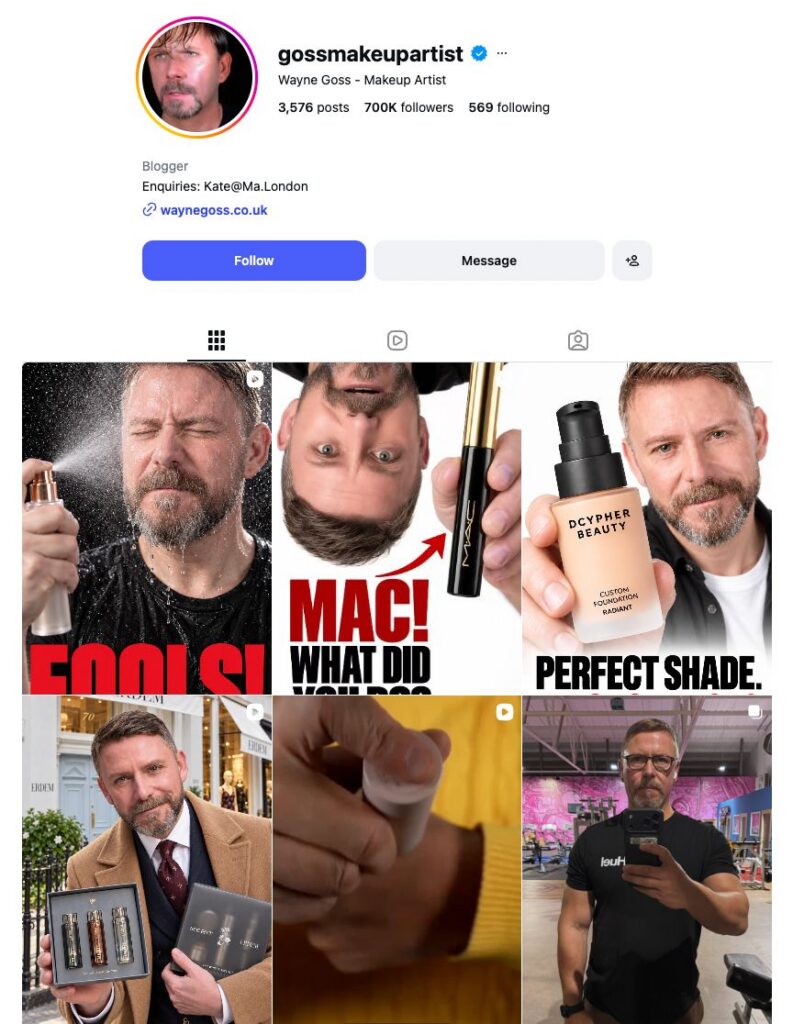
Wayne Goss built his YouTube following by translating professional makeup artist techniques into consumer-friendly tutorials. His approach centers on facial anatomy, product performance, and realistic expectations. Goss addresses common frustrations like creasing, patchiness, and color matching by explaining the technical reasons products fail and how to correct them.
His background as a working makeup artist gives him credibility when he critiques product formulations or challenges popular techniques that don't hold up under real-world conditions. The value for viewers comes from understanding makeup mechanics rather than memorizing specific product combinations that might not translate to their own face.
His YouTube channel focuses on technique over trends, explaining facial planes, bone structure, and how these affect product placement. He regularly walks through why certain viral hacks fail under scrutiny, and he's launched his own brush line built around professional tool-design principles. His videos tend to run 8 to 15 minutes with minimal editing, prioritizing instructional time, and he explicitly addresses older skin, texture, and imperfect canvases rather than only demonstrating flawless base work. His standing among top beauty influencers comes from technical education rather than entertainment value.
2. Lisa Eldridge
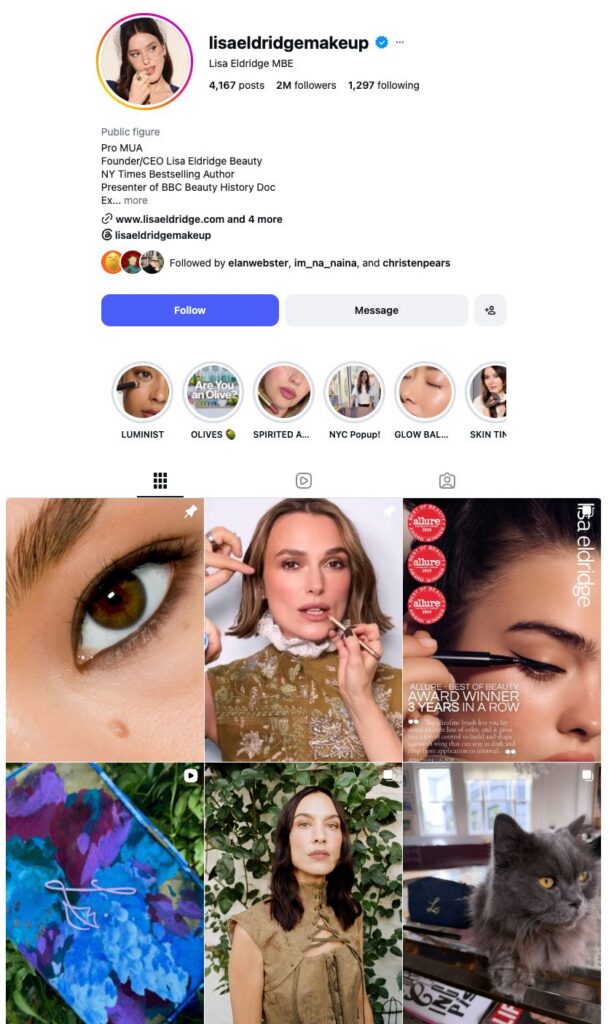
Lisa Eldridge approaches beauty education from an editorial and historical perspective, having worked on major fashion shoots and with luxury brands throughout her career. Her YouTube content combines modern techniques with historical context, showing how makeup trends evolved and why certain application methods have persisted across decades.
Eldridge teaches viewers to think about makeup as a creative medium rather than a corrective tool. Her tutorials often reference art history, vintage beauty practices, and cultural influences on contemporary trends, which gives viewers a broader framework for developing personal style rather than chasing whatever look is trending that week. She also runs her own makeup line, built around a philosophy of versatile, buildable products.
Her career includes work with Vogue, major fashion houses, and global beauty campaigns, and her YouTube tutorials incorporate art references and historical makeup techniques alongside color theory and editorial looks adapted for everyday wear. Her videos tend to feel closer to masterclasses than quick tips, with a strong focus on how application tools affect finish. Notably, she addresses mature skin without framing it through an "anti-aging" lens, which is a meaningful shift from how most beauty content approaches that audience. She launched her own makeup brand in 2018, built around gaps she identified through her editorial work. Her reputation among popular beauty influencers reflects decades of professional credibility translated into genuinely accessible education.
3. Robert Welsh
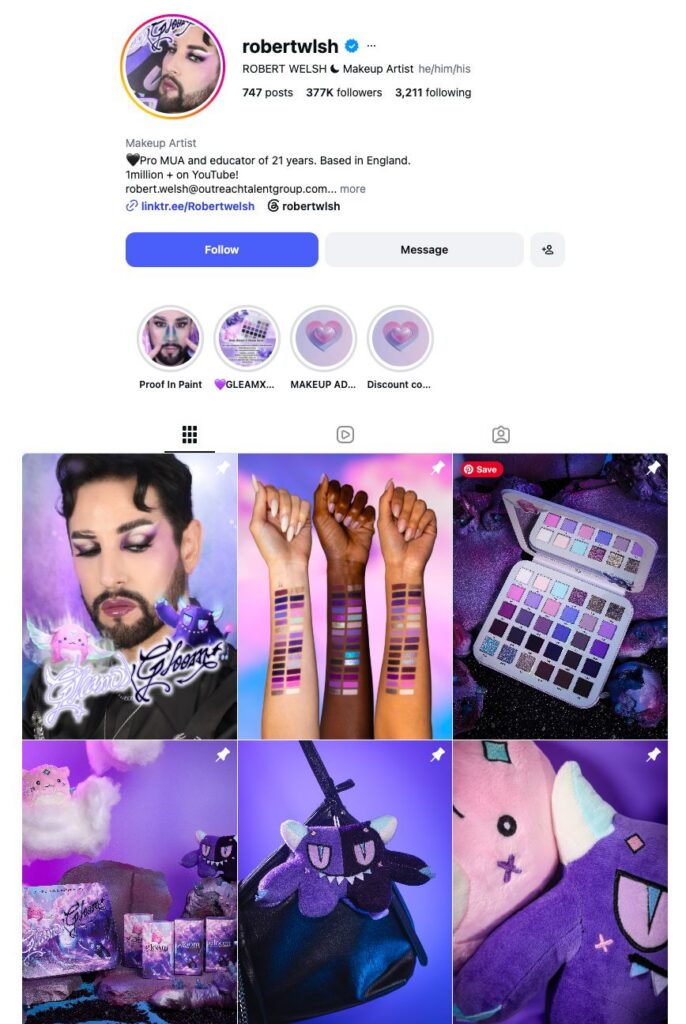
Robert Welsh positions himself as a beauty educator actively working against misinformation spread through viral beauty content. As a professional makeup artist, he creates reaction videos that dissect popular tutorials, explaining what works, what doesn't, and why.
This approach teaches critical thinking alongside technique. Welsh regularly makes the point that expensive products don't guarantee better results, often demonstrating drugstore alternatives that perform identically to luxury items in side-by-side tests. His content appeals to viewers who want to build their own discernment rather than simply follow instructions.
He's known for his "Real MUA Reacts" series, where he analyzes viral beauty content and explains why certain techniques can damage skin or produce unflattering results. He's a consistent advocate for realistic beauty standards and achievable looks, and he regularly compares drugstore and luxury products that deliver identical results. He also teaches viewers how to spot misleading before-and-after editing. He collaborates frequently with his twin brother, James Welsh, who focuses on skincare, and together their two channels form a fairly comprehensive beauty education resource. Welsh maintains a presence on both YouTube and TikTok, adapting content length to each platform's format. His cross-platform strategy positions him among TikTok beauty influencers who prioritize education over chasing trends, and his presence demonstrates that critical analysis can thrive even on a platform typically associated with quick, trend-driven content.
Influencers Who Build Inclusive Beauty Frameworks
Mainstream beauty education has historically centered light skin, Eurocentric features, and cisgender perspectives. The influencers in this category aren't adapting existing techniques for underrepresented audiences; they're building original methodologies from scratch.
This includes color science developed specifically for deep skin tones, techniques accounting for different hair textures in makeup application, and gender-expansive approaches to beauty education. These influencers often fill educational gaps that legacy beauty media simply ignored, and their work tends to benefit everyone by expanding the technical vocabulary available across beauty education generally.
Inclusion in this context means representation in who teaches, whose challenges get addressed, and which aesthetics get centered as the default. The frameworks built by the creators below have increasingly become industry standards rather than remaining niche alternatives. Male beauty influencers and transgender beauty influencers within this category demonstrate how expanding whose voices lead beauty education tends to produce better techniques and more meaningful product innovation across the industry as a whole.
| Framework Type | Educational Gap Addressed | Example Application |
| Deep Skin Tone Color Science | Foundation oxidation, undertone matching, dimension without ashiness | Testing darkest shades, evaluating true depth range |
| Gender-Expansive Techniques | Makeup application across facial hair, removing gendered product marketing | Tool selection, placement strategies for varied features |
| Cultural Beauty Standards | South Asian hyperpigmentation, textured hair considerations in makeup | Color correction methods, product formulations for specific concerns |
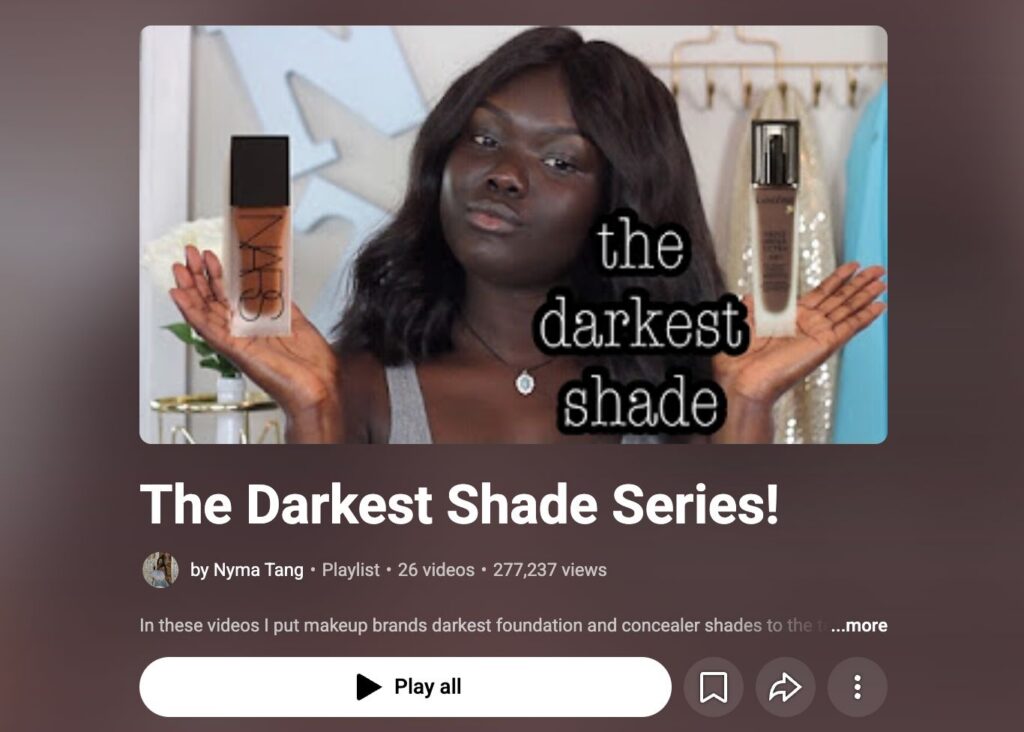
4. Nyma Tang
Nyma Tang created her YouTube series "The Darkest Shade" in 2017 to address a chronic problem: beauty brands regularly launching foundation ranges that exclude deep skin tones entirely. Her reviews specifically test the darkest shade available in each brand's range, evaluating whether it's actually dark enough and assessing undertone accuracy.
This systematic approach turned individual frustration into data-driven advocacy that has pressured brands to expand their shade ranges over time. Tang's impact extends beyond the reviews themselves; she effectively established a framework for accountability that other creators and consumers continue to use. Her approach shows how a single influencer can shift industry standards by introducing measurable evaluation criteria where none previously existed.
"The Darkest Shade" systematically reviews foundation ranges using a consistent rating approach that evaluates depth, undertone accuracy, and oxidation over time. The series documents which brands genuinely serve deep skin tones versus those making a performative gesture toward inclusivity. Her advocacy is widely credited as part of the pressure that pushed brands like Fenty Beauty to raise the standard for inclusive shade ranges industry-wide. She's since applied the same critical lens to other product categories, and her YouTube channel now functions as something of an archive for foundation testing across hundreds of brands, with comment sections that have become community resources where viewers share their own shade matches. Her systematic methodology positioned her among the most influential beauty educators driving measurable industry change rather than simply commenting on it from the sidelines.
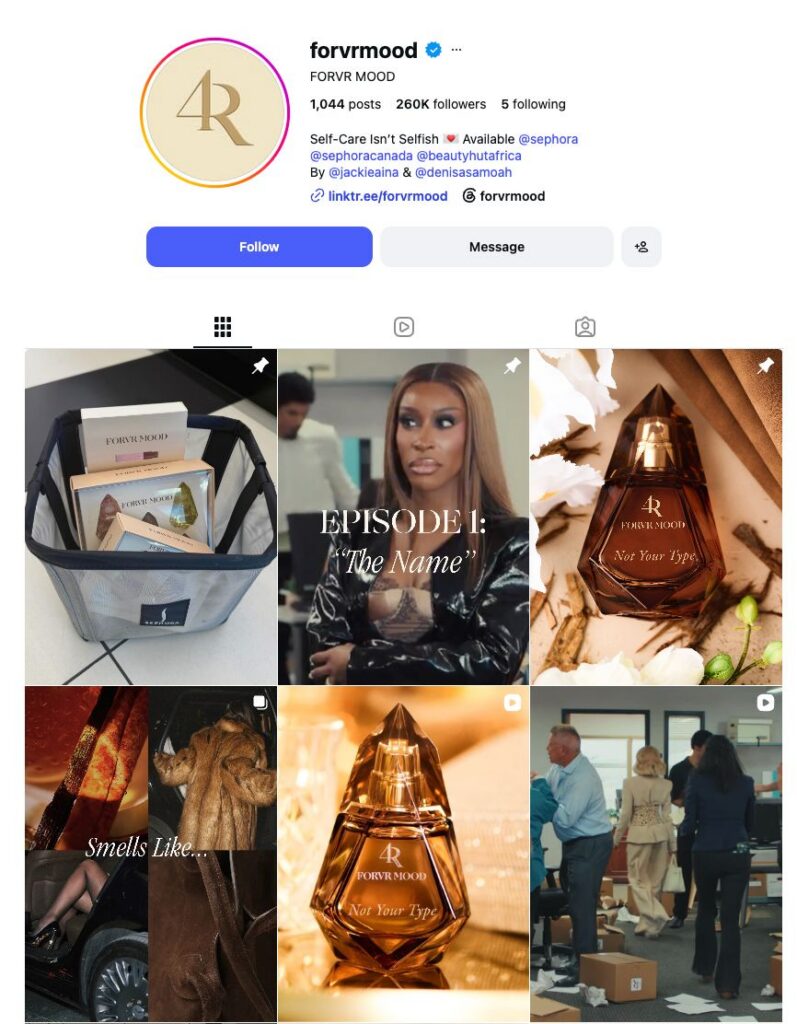
5. Jackie Aina
Jackie Aina combines beauty education with business transparency and industry critique. Her tutorials for deep skin tones cover techniques mainstream content frequently overlooks: color-correcting hyperpigmentation, working with the natural undertones common in melanin-rich skin, and achieving visible dimension without ashy results.
Beyond tutorials, Aina has been vocal about publicly calling out brands for diversity failures, and she shares behind-the-scenes realities of what influencer partnerships actually look like. She launched her own candle company, FORVR Mood, and has been transparent about the specific challenges of Black entrepreneurship in the beauty space. That combination of skill-building content and industry commentary helps viewers understand both the technique itself and the business context shaping which products actually reach the market.
Her YouTube channel focuses on deep skin tone techniques and product recommendations, and she's openly discussed which brand partnerships she's declined and why. She teaches color theory specific to melanin-rich skin, and she addresses texture, scarring, and hyperpigmentation without framing any of them as flaws that need to be hidden. She co-created a palette with Anastasia Beverly Hills after years of publicly advocating for deeper shade ranges, and she's been candid about the entrepreneurship process behind FORVR Mood, at times sharing the actual emails and messages that illustrate how brands approach influencer partnerships. Her cross-platform presence has established her as one of the influencers beauty brands engage for genuinely authentic partnerships rather than performative diversity campaigns, and her standing among beauty influencers on Instagram reflects years of consistent advocacy paired with technical skill.
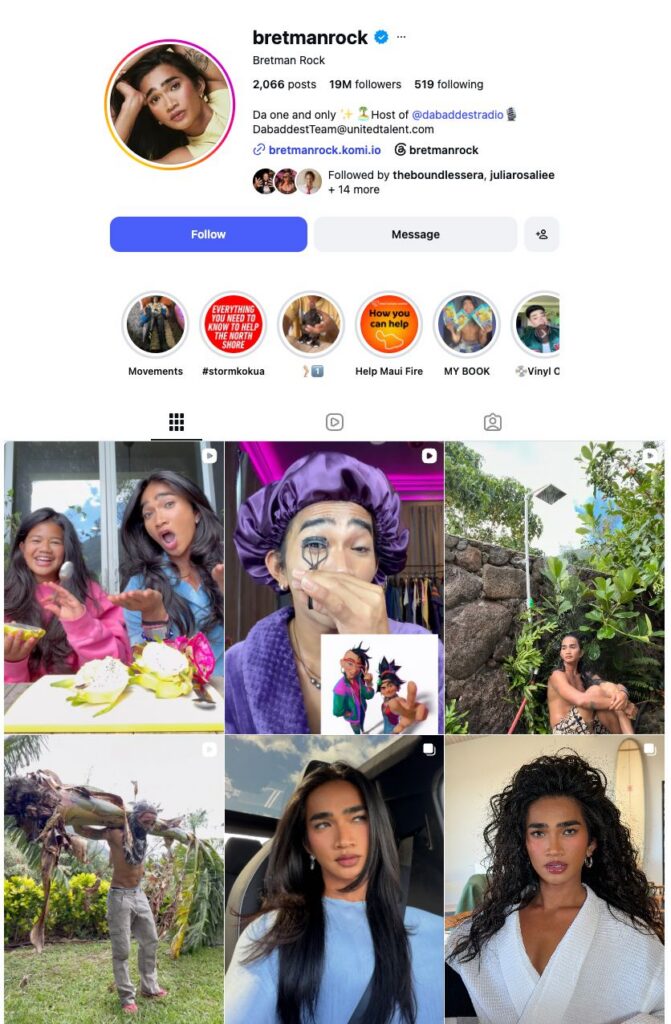
6. Bretman Rock
Bretman Rock built his following by combining technical makeup skill with unapologetic queer Filipino representation. His content doesn't separate beauty from cultural identity; he regularly incorporates Ilocano language, Filipino family dynamics, and queer humor directly into his tutorials.
Rock's approach shows viewers that beauty education doesn't require code-switching or cultural erasure to reach a broad audience. His techniques often address tropical climate conditions, humidity-resistant and long-wear application, and bold color experimentation that translates across different settings. He's expanded well beyond beauty content into broader lifestyle and entertainment work while still maintaining makeup as a core skill he teaches.
His career trajectory, starting on Vine and transitioning successfully to YouTube, Instagram, and TikTok, demonstrates how a beauty creator can expand impact while staying rooted in the communities they represent. He integrates Filipino language and cultural references throughout his content, and his techniques account for tropical climate realities like humidity resistance. His queer perspective is presented as normalized rather than treated as niche content, and he successfully crossed into mainstream entertainment, including an MTV reality show, while retaining his core audience. His product recommendations tend to account for accessibility and performance under genuinely challenging conditions. His mainstream crossover success positions him among the beauty influencers whose work shows that cultural specificity strengthens rather than limits educational appeal.
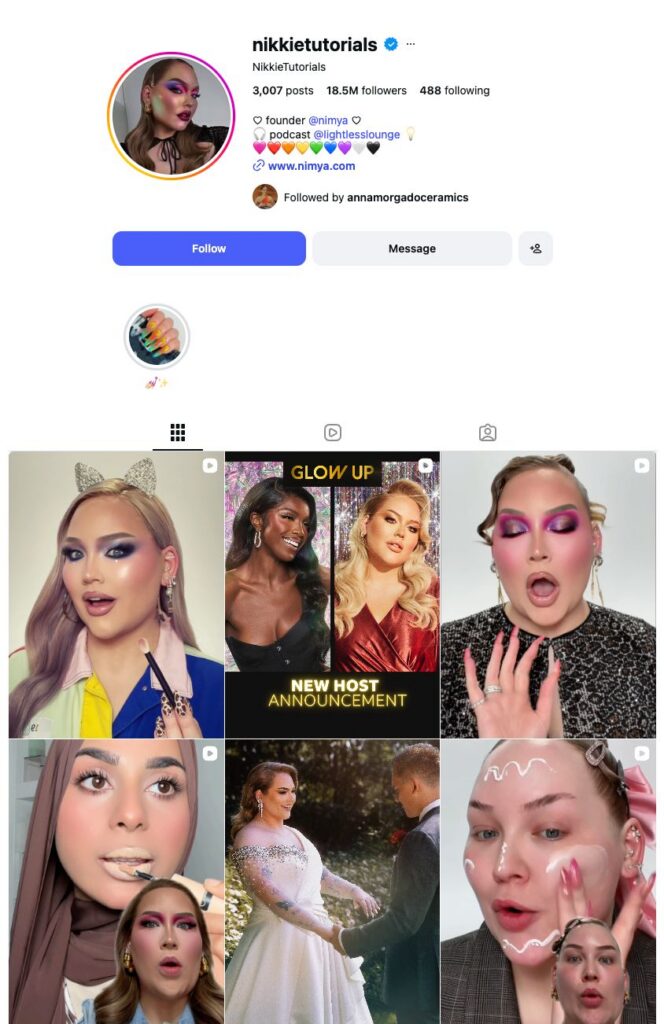
7. Nikkie de Jager (NikkieTutorials)
Nikkie de Jager gained widespread recognition for her "The Power of Makeup" video, which challenged stigma around visible makeup by showing dramatic transformations on half of her face at a time. Her tutorials showcase advanced techniques including extreme highlighting, editorial eye looks, and full-coverage application.
In January 2020, de Jager came out publicly as a transgender woman, revealing in an emotional video that she had been the target of blackmail from people threatening to leak her story to the press. As multiple outlets reported at the time, she said she had always planned to share her story on her own terms, but the blackmail attempt forced her hand. She has since described transitioning with hormones as a teenager and fully transitioning by age 19. Her decision to come out publicly turned her platform into a vehicle for visibility advocacy while she continued to focus on makeup artistry. Her content demonstrates that highly skilled technical work and personal authenticity aren't competing priorities, and she consistently emphasizes that makeup exists for self-expression rather than conformity.
Her "Power of Makeup" video went viral and reshaped broader conversations about makeup visibility and gender norms in beauty content. She's known for full-glam, editorial-level techniques adapted for everyday use, and she's collaborated with major brands including her own Maybelline palette. She teaches advanced color matching, extreme highlighting, and dimension-building techniques, and her content generally balances aspirational looks with more wearable adaptations. She also hosted the Eurovision Song Contest in 2021, expanding her platform beyond beauty content while staying connected to her roots as a makeup educator. Her visibility positions her among transgender beauty influencers whose work demonstrates that representation and technical excellence reinforce each other rather than compete.
8. Manny MUA
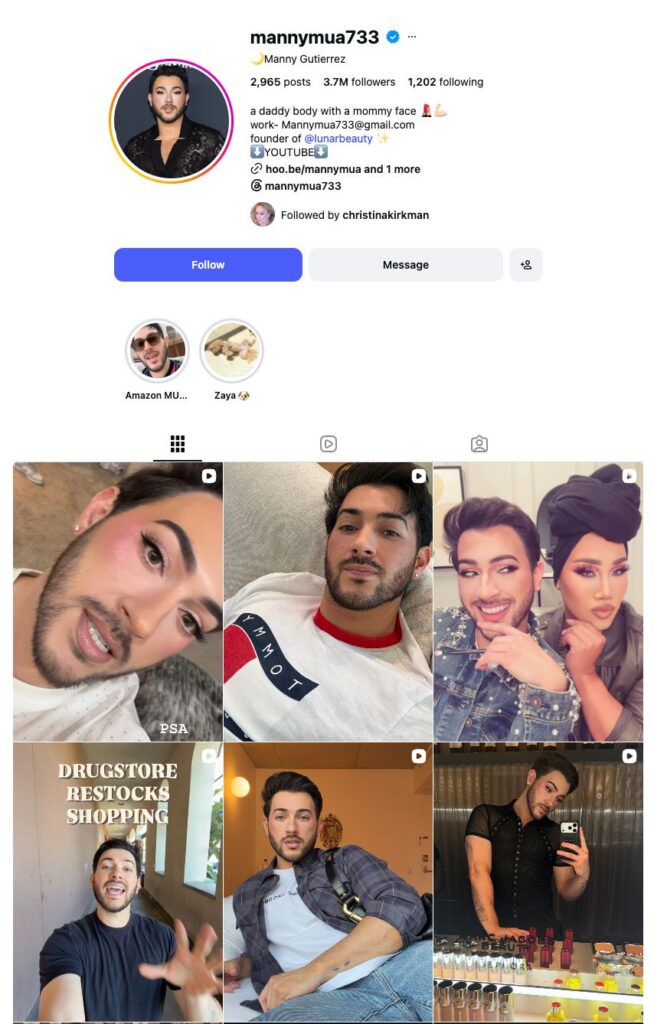
Manny Gutierrez, known as Manny MUA, became the first male brand ambassador for Maybelline, a notable milestone for men in mainstream beauty partnerships. His content focuses on accessible glam looks, drugstore product reviews, and makeup techniques that work across gender expressions.
Manny launched his own brand, Lunar Beauty, built around gaps he identified in the market. His broader approach normalizes makeup as a skill and art form available to everyone, rather than territory defined by gender. The educational value in his content comes largely from demystifying products and techniques that beauty marketing often gender-codes unnecessarily, which makes the underlying education more accessible to male and gender-nonconforming audiences who often face real barriers in traditional beauty retail spaces.
As the first male Maybelline brand ambassador, he created meaningful visibility for men pursuing beauty partnerships. His YouTube content emphasizes accessible techniques and drugstore options, and he founded Lunar Beauty in 2018 around the specific gaps he'd identified. He collaborates with other male beauty influencers, contributing to a broader sense of community and normalization, and he reviews products without gender-coded language or assumptions baked in. He also addresses practical considerations like facial hair in makeup application, a reality that most mainstream content simply ignores. His techniques generally focus on self-expression rather than conforming to masculine or feminine beauty standards. His early partnerships helped establish a foundation that made retail and brand collaborations more accessible to other creators who followed.
9. Alissa Ashley
Alissa Ashley specializes in tutorials for hooded eyes and deep skin tones, two areas that remain frequently underserved in mainstream beauty education. Her techniques address specific, recurring challenges: eyeshadow disappearing once the eye is open, eyeliner application suited to hooded eye shapes, and achieving visible dimension on deep skin.
Ashley's methodical approach breaks down each step with clear explanations of placement and why standard techniques often fail for these particular eye shapes and skin tones. Her content makes a compelling case that specialized education produces better results than trying to adapt generic tutorials that weren't designed with these features in mind. She also reviews products specifically for their performance on deep skin and hooded eyes, offering targeted recommendations that can save viewers both money and frustration.
Her YouTube channel centers on hooded eye techniques and deep skin tone application, explaining eyeshadow placement that remains visible with eyes open, and eyeliner techniques adapted for limited lid space. Her product testing specifically evaluates performance on hooded eyes and melanin-rich skin, and her tutorials generally treat these features as the default rather than as variations to adapt around. Her pacing tends to be clear and methodical, prioritizing instruction over entertainment value.
10. Patrick Starrr
Patrick Simondac, known as Patrick Starrr, built his career as a professional makeup artist before transitioning into influencer work, bringing genuine technical credibility to his educational content. His tutorials range from everyday looks to editorial glam, covering the full spectrum from subtle to transformative application.
Starrr launched his One/Size beauty brand with an explicit focus on inclusive shade ranges and formulations designed to work across different skin types. His content also addresses body size and beauty, helping normalize plus-size visibility in beauty content that has historically excluded larger bodies. The combination of professional technique, product development insight, and representation work creates educational value that extends well beyond any individual tutorial.
His professional makeup artist background includes celebrity and editorial clients, and his YouTube tutorials cover techniques ranging from everyday to full editorial looks. He launched One/Size in 2020 with inclusive shade ranges and universal formulations, and he's been open about discussing body size and representation within the beauty industry. His collaboration with MAC Cosmetics helped expand male representation among major beauty brands, and his product reviews often include performance testing across different climates and occasions. He also shares behind-the-scenes content from professional shoots, effectively teaching studio techniques to his audience. His industry standing positions him among the beauty influencers whose brand partnerships demonstrate the commercial viability of genuinely inclusive representation.
11. Deepica Mutyala
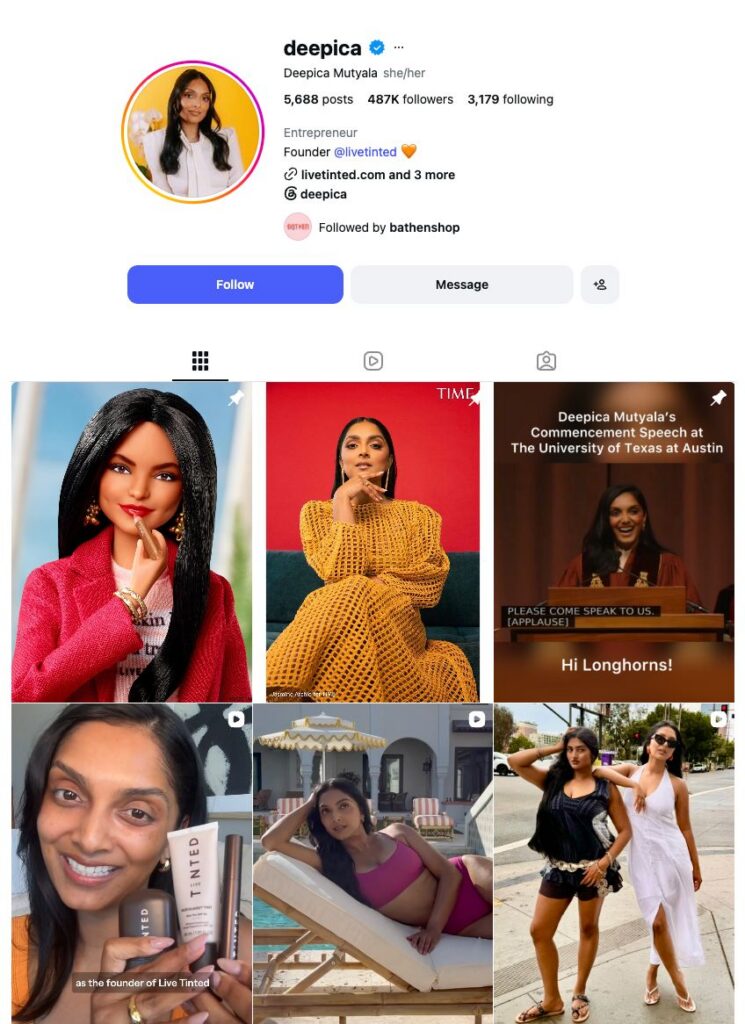
Deepica Mutyala creates content specifically for South Asian beauty concerns, addressing hyperpigmentation, dark circles, and undertone matching that mainstream beauty education has frequently ignored. Her viral 2015 video demonstrating how to cover dark circles using red lipstick as a color corrector has been viewed more than 10 million times, and it addressed a problem that affects many South Asian individuals along with others who have deep-set pigmentation.
Mutyala founded Live Tinted, a beauty brand centered on South Asian skin tones and built around the idea of "tinted" as an empowering identity rather than an othering one. Her educational approach combines practical technique with genuine cultural affirmation, helping South Asian viewers see themselves represented in beauty spaces that have historically excluded them.
Her viral dark circle video remains one of the most widely referenced beauty tutorials tied to a specific cultural need, and her content continues to address South Asian skin concerns including hyperpigmentation and undertone complexity. She founded Live Tinted in 2018, building products specifically for deeper skin tones, and her educational content consistently combines technique with cultural representation. She's discussed colorism and beauty standards within South Asian communities directly, and her product recommendations account for undertones and pigmentation patterns common in South Asian skin. She's also been candid about her own experiences feeling excluded from mainstream beauty spaces growing up. Her culturally specific approach positions her among the beauty influencers building frameworks that serve underrepresented communities while expanding the technical vocabulary available to beauty educators generally.
Influencers Who Decode Product Science and Skin Biology
Product science influencers translate dermatology research, cosmetic chemistry, and ingredient functionality into language consumers can actually use. They explain what products can and can't realistically do, based on formulation science rather than marketing copy. This category matters because beauty marketing frequently makes claims that outpace what the underlying science actually supports.
These creators help viewers spend money on products that work rather than chasing promises that don't hold up. Their education focuses on skin biology, ingredient interactions, and evidence-based practices, and they regularly debunk myths, explain why certain ingredient combinations cause problems, and teach viewers how to evaluate products on their own. That kind of scientific literacy helps prevent wasted money and, in some cases, genuinely harmful skincare practices. Many of these influencers either have formal scientific backgrounds or extensively research peer-reviewed literature as part of their content process, and their work tends to counter the instant-results culture that dominates so much of beauty marketing by explaining realistic timelines for how skin actually responds to ingredients.
| Scientific Focus Area | What They Teach | Practical Application |
| Ingredient Chemistry | What active ingredients do, effective concentrations, formulation stability | Reading ingredient lists, identifying marketing vs. efficacy |
| Skin Barrier Function | How skin protects itself, what damages barriers, repair mechanisms | Building routines that support rather than compromise skin health |
| Dermatological Research | What peer-reviewed studies actually show, study quality evaluation | Distinguishing evidence-based claims from pseudoscience |
12. Hyram Yarbro
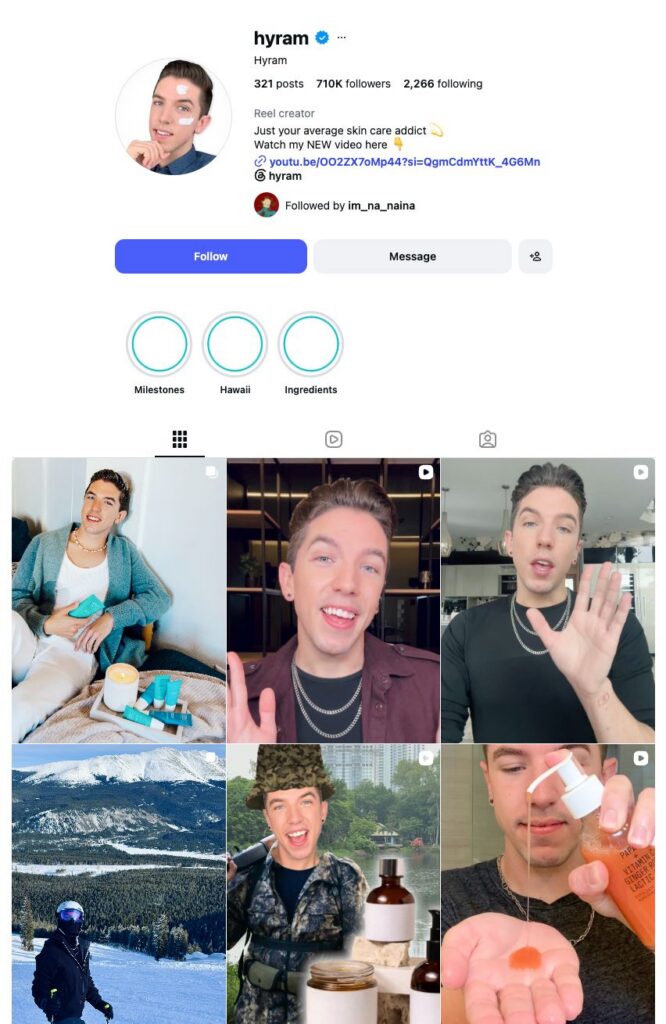
Hyram Yarbro gained popularity by breaking down skincare ingredient lists and explaining what each component actually does. His genuine enthusiasm for ingredient education helped make fairly complex formulation information accessible to a general audience. Hyram reviews products based on their formulation rather than brand prestige, and he regularly recommends more affordable alternatives to luxury items when the underlying ingredients are comparable.
He consistently emphasizes sunscreen use, simple routines, and evidence-based practices over trend-driven purchases. His broader approach helps democratize skincare knowledge that brand marketing often deliberately obscures. Hyram doesn't have formal scientific training, and he's generally clear about that limitation, encouraging viewers to consult dermatologists directly for medical skin concerns rather than positioning himself as a substitute.
His YouTube and TikTok content focuses on ingredient breakdowns and formulation analysis across price points, with a consistent emphasis on ingredient value over brand name. He's partnered with skincare brand Inkey List while still maintaining critical reviews across other brands, and he regularly addresses common skincare myths with evidence-based explanations. His accessible communication style has made scientific concepts genuinely understandable to a broad audience, and his multi-platform presence establishes him among the social media beauty influencers who've built real authority through consistent educational value rather than credentials alone.
13. James Welsh
James Welsh, Robert Welsh's twin brother, approaches skincare education with meticulous research and measured recommendations. His content consistently emphasizes that skincare requires patience, consistency, and realistic expectations rather than instant transformation. Welsh reviews scientific studies, explains dermatological concepts, and critiques products based on formulation quality.
He collaborates directly with dermatologists and skincare chemists to help ensure the accuracy of his educational content. His broader approach counters the instant-results culture common in beauty marketing by teaching viewers how skin actually responds to products over realistic timelines. His reviews consider ingredient concentrations, pH levels, and delivery systems rather than simply repeating marketing claims, and that scientific rigor helps viewers build their own evaluation skills rather than depending entirely on individual product recommendations.
His YouTube channel emphasizes research-backed skincare education, citing scientific studies and dermatological principles throughout. He collaborates with dermatologists and cosmetic chemists for accuracy, and he consistently critiques products based on formulation quality rather than marketing positioning. He teaches viewers how to read ingredient lists and understand active concentrations, emphasizes realistic timelines for seeing results, and addresses common skincare myths with evidence-based explanations.
14. Michelle Wong (Lab Muffin Beauty Science)
Michelle Wong holds a PhD in chemistry and translates peer-reviewed cosmetic science research into accessible beauty education. Her blog and YouTube channel explain the chemistry behind skincare ingredients, why certain product combinations cause problems, and what the actual scientific evidence supports for various beauty claims.
Wong debunks pseudoscience in beauty marketing while still explaining the legitimate benefits certain ingredients do offer. She covers topics including sunscreen chemistry, the role of pH in skincare, and how preservative systems function. Her scientific credentials let her evaluate research quality directly and identify when a study is being misrepresented in marketing materials, which is a meaningfully different level of scrutiny than most beauty content applies. That kind of credibility-backed transparency is closely related to the broader principle SPIRRA covers in its piece on authenticity in influencer marketing, where verifiable expertise, not just follower count, is what actually earns audience trust.
This level of scientific rigor gives viewers a genuinely reliable information source in an industry that's often saturated with misleading claims. Her academic background is in chemistry with a specialty in cosmetic science, and her blog and YouTube content explain skincare chemistry and ingredient science while reviewing peer-reviewed research and evaluating its quality directly. She debunks pseudoscience common in beauty marketing, explains sunscreen chemistry, preservative systems, and pH science, and collaborates with dermatologists and other scientific experts. Her content generally balances scientific accuracy with genuinely accessible language, positioning her among the educators most useful to readers trying to find beauty influencers who provide verifiable scientific information rather than marketing-driven product promotion. Trust in this kind of content isn't abstract: per that same BeautyMatter research, 69% of consumers say they trust beauty influencers more than they trust traditional advertisements, which makes scientific accuracy in that content especially consequential for preventing misinformed purchasing decisions.
15. Gothamista (Renée)
Renée, known as Gothamista, specializes in Asian beauty products and the ingredient innovation common in Korean and Japanese skincare formulations. Her content explains why certain ingredients popular in Asian beauty differ meaningfully from typical Western formulations, and how to integrate them effectively into an existing routine.
Gothamista reviews products with close attention to formulation quality, ingredient concentrations, and skin type considerations. She teaches viewers about fermented ingredients, essences, and multi-step routines, while consistently emphasizing that adding more steps doesn't automatically produce better results. Her overall approach balances genuine enthusiasm for formulation innovation with a critical eye toward marketing claims.
Her YouTube channel focuses on Asian beauty products and ingredient analysis, explaining Korean and Japanese skincare innovations and the formulation approaches behind them. She evaluates fermented ingredients, essences, and specialized treatments, and her multi-step routine education emphasizes personal customization over rigid, one-size-fits-all protocols. Her reviews weigh ingredient concentrations and formulation quality carefully, and she addresses different skin types and concerns with targeted recommendations rather than blanket advice. She also discusses sustainable and ethical practices among Asian beauty brands. Her platform presence has established her among Korean beauty influencers building communities around genuine ingredient education, reflecting deep expertise in formulation analysis specific to innovation coming out of the Asian beauty market.
16. Charlotte Palermino (Dieux Skin)
Charlotte Palermino combines licensed esthetician credentials with co-founding Dieux Skin, a brand built around a stated commitment to transparency about formulation costs and ingredient sourcing. Her content educates on skin barrier health, ingredient interactions, and a realistic picture of what skincare can actually achieve versus what marketing promises.
Palermino has been notably open about sharing production costs and markup structures, and about explaining why certain ingredients carry a genuinely higher cost while others don't, despite premium pricing on the finished product. That same transparency extends into her product reviews and broader ingredient education. She's a consistent critic of industry practices that exploit consumer knowledge gaps, and she teaches viewers how to identify when marketing claims diverge from formulation reality.
Her licensed esthetician background is paired with a clinical skincare orientation, and her content consistently focuses on skin barrier health and setting realistic product expectations. She explains ingredient sourcing, stability challenges, and formulation trade-offs directly, and she advocates for evidence-based skincare over trend-driven purchasing. Her unique position as both a brand founder and a transparent educator places her among a smaller group of beauty influencers who choose to disclose the business mechanics that most creators leave out entirely.
The broader industry context helps explain why this kind of transparency carries real weight. Social commerce markets were projected to exceed $1.2 trillion by the end of 2025, per Accenture data cited in BeautyMatter's research, with beauty capturing more than 40% of digital spend in key markets. That scale makes transparent education about formulation and pricing increasingly valuable as consumers navigate an environment full of aggressive, high-volume marketing.
17. Susan Yara (Mixed Makeup)
Susan Yara built Mixed Makeup into a platform for ingredient-focused skincare education well before launching Naturium, an affordable skincare brand built around clinical-grade ingredients at accessible prices. Her content explains active ingredients, percentage concentrations, and how to build a routine based on actual skin concerns rather than marketing narratives.
In June 2020, Yara faced significant public backlash after revealing she was co-founder of Naturium, a brand she had already been promoting on her platform for weeks without disclosing her financial stake in it, which raised real questions about compliance with FTC influencer disclosure guidelines. She posted an apology video acknowledging the lack of disclosure and explaining the timeline of her involvement, and she and her team subsequently added clear disclosure language to her content going forward. The episode became a widely cited case study in influencer transparency requirements, and it illustrates why disclosure and brand-safety practices matter as much for established, trusted creators as for anyone else. Naturium has since grown substantially: the brand was acquired by e.l.f. Beauty for $355 million, a deal Yara has spoken about publicly alongside the earlier controversy and the FTC review that followed.
Beyond that chapter, her educational content continues to provide real ingredient knowledge and formulation insight. Her YouTube channel focuses on ingredient education and skincare science, and Naturium itself is built around offering clinical-grade ingredients at drugstore price points. She explains active ingredient percentages and formulation quality in detail, and her content teaches routine-building based on skin concerns and ingredient compatibility, reviewing products across price points with a consistent focus on formulation value. Her experience underscores why disclosure isn't a minor footnote in influencer partnerships, and it's a useful real-world reference point for anyone building out brand-safety practices around influencer relationships.
Finding Beauty Influencers Who Match Your Learning Style
The beauty influencer space contains thousands of creators, which makes it genuinely difficult to identify educators who provide real skill-building value versus creators optimized primarily for entertainment. We focused on the 17 creators above, across technical application, inclusive frameworks, and product science, because each has demonstrated consistent educational quality over time.
Your own learning preferences matter when deciding which influencers to follow. Some people absorb information more effectively through quick TikTok demonstrations, while others benefit from longer, more detailed YouTube explanations. Platform matters less than whether a given teaching style actually matches how you process information. The same underlying principles that apply to a brand identifying the right influencer for a partnership apply here too, just applied to personal learning instead of campaign fit.
It's worth cross-referencing recommendations across multiple creators to verify claims and build your own evaluation skills over time, rather than treating any single source as definitive. The goal isn't to follow every influencer covered here; it's identifying which educational approach actually serves your specific needs. Building real beauty skills requires moving from passive viewing into active practice of the techniques you've learned.
A few practical filters worth applying: match platform choice to your learning style, TikTok for quick visual demonstrations, YouTube for more in-depth instruction. Pay attention to whether a creator cites sources or explains their underlying reasoning, since that's often a better signal of educational value than production quality. Real educational value shows up in your own ability to replicate a technique independently, which requires active practice rather than passive consumption. It's also worth considering whether a creator's face shape, skin type, or features are similar enough to yours that their specific techniques will translate directly. Transparency about brand partnerships and financial relationships matters for trust, as Susan Yara's experience above illustrates directly. You don't need to follow everyone on this list; finding three to five creators whose teaching genuinely resonates is enough.
This same evaluation logic scales up for brands and agencies, not just individual learners. According to Nielsen research cited in that same BeautyMatter analysis, 92% of consumers trust user-generated content more than branded content, which is a big part of why finding beauty influencers who prioritize genuine education over sponsored promotion has real, measurable impact on both learning outcomes and campaign performance.
When You Need More Than Manual Influencer Discovery
Scrolling through beauty influencer content manually works reasonably well when you're building your own personal skills. Brands and agencies evaluating dozens or hundreds of potential creator partnerships need a more systematic approach. Finding beauty influencers whose audiences genuinely align with your brand's values, and whose content style actually matches your campaign goals, requires data that native platform tools generally don't expose.
SPIRRA's AI-powered influencer discovery platform is built around that exact gap. It provides Audience Alignment Score™, Brand Alignment Score™, and Content Alignment Score™ metrics that go well beyond surface-level indicators like follower count. The platform's verified influencer network is designed to reduce fraud and fake-follower risk, while advanced filtering helps distinguish genuine educators from entertainers, and technical experts from broader lifestyle creators, across a searchable database that SPIRRA describes as covering roughly 18 to 19 million influencers.
You can discover beauty influencers across Instagram, YouTube, and TikTok within a single search, filtering by the specific educational frameworks or representation priorities that matter most for your brand. Manual discovery simply doesn't scale once you're running multiple campaigns at once, and native platform tools generally don't surface audience-quality or brand-alignment data on their own. Whether you're searching for YouTube beauty influencers suited to long-form tutorials or Instagram-focused creators built for visual impact, SPIRRA's AI-powered influencer discovery platform is designed to support unified discovery across all three formats from one place.
Ready to find beauty influencers who build genuine educational value for your audience? Schedule a demo with SPIRRA to see how alignment scoring can transform how your team discovers and vets creator partnerships.
Final Thoughts
Most beauty influencer lists celebrate aesthetic appeal or follower counts. We focused on educational transfer instead, because that's what creates value that actually outlasts a single viewing. The 17 creators covered here teach frameworks you can apply independently, building real competency rather than ongoing content dependency.
Technical application experts like Wayne Goss, Lisa Eldridge, and Robert Welsh decode professional methods into genuinely repeatable systems. Inclusive framework builders including Nyma Tang, Jackie Aina, Bretman Rock, and Deepica Mutyala have built beauty education for audiences that mainstream content has historically excluded. Product science communicators like James Welsh, Michelle Wong, and Charlotte Palermino provide the ingredient literacy and formulation knowledge that helps prevent wasted money on products that were never going to deliver on their marketing promises.
The common thread running through all three categories is that these creators teach you how to think about beauty, not just what to buy or which trend to follow next. Your own skill development depends on moving from passive viewing into active practice, and the most valuable creators are the ones whose lessons remain useful long after you've finished watching. That evaluation framework, prioritizing teaching over aesthetics, and transparency over pure production polish, holds up well beyond these specific 17 creators, and it's worth applying the next time a beauty tutorial shows up in your feed.