
Influencer marketing on Instagram has become a parody of itself. Brands chase follower counts, creators optimize for engagement pods, and audiences scroll past sponsored content with the same energy they use to skip YouTube ads. The channel that was supposed to feel authentic has been turned into a billboard with a personality filter.
The real shift happening right now isn't about finding bigger creators or better hashtags. It's about recognizing that instagram influencer marketing stopped being about influence years ago and became about distribution. That's the problem. And that's also where the opportunity lives for brands willing to rethink their entire approach to the channel from the ground up.
TL;DR
- Instagram influencer marketing has become a distribution model, not an influence model, which is why most campaigns feel hollow and perform below projection
- Brands are buying reach instead of actual influence, missing the only thing that made this channel worth investing in
- The creator economy is fracturing into specialized micro-economies where niche communities deliver better ROI than broad audiences
- Instagram's algorithm actively suppresses promotional content, making traditional influencer posts less effective by design
- Disclosure requirements have created an authenticity paradox where legal transparency undermines audience trust
- Most brands measure the wrong metrics and miss the signals hidden in comment quality and conversation depth
- The first 48 hours after posting determine whether content earns algorithmic amplification or dies in obscurity
- Long-term partnerships outperform one-off campaigns by significant margins, but most brands still default to transactional relationships
- Audience ownership matters more than follower count because platforms control distribution, not creators
- User-generated content is quietly outperforming traditional influencer content as the format audiences trust most
The Distribution Trap: Why Reach Became the Only Metric That Matters
How Brands Confused Impressions With Impact
Brands started buying influencer posts the same way they buy banner ads. Impressions became the primary currency because they're easy to report in a deck. You can show your CMO a number that looks big and feels safe. Your agency can benchmark it against CPMs and produce a slide that looks like media planning rigor.
The problem is that impressions don't mean someone cared. They don't mean someone stopped scrolling. They don't mean someone changed their mind about your product. Influencer marketing worked initially because it wasn't advertising. It was a trusted person telling their community about something they genuinely used. That trust created influence. The moment brands optimized for reach, they optimized away the only thing that made the channel worth paying for. You can't buy influence. You can only rent distribution. Most brands are doing the latter while measuring it as if it were the former. The gap between what you think you're buying and what you're actually getting is where program budgets quietly disappear.

Why Follower Count Became the Wrong Proxy
Follower count is visible, comparable, and feels objective. That's why it became the default evaluation metric across the industry. But it tells brands almost nothing about whether a creator can actually move their product.
A creator with 500K followers may have built that audience through viral entertainment content. Their community isn't there for product recommendations. They're there for the show. When that creator posts about your skincare line, the audience doesn't just ignore it. Many of them feel the interruption as a violation of the implicit contract they had with that creator. The follower count said nothing about audience intent, category relevance, or purchase propensity. It only measured scale.
Meanwhile, a creator with 20K followers who built their audience reviewing products in your exact category has an audience that shows up specifically for purchase guidance. They're pre-qualified, attentive, and actively seeking recommendations. Follower count measures how many people once clicked follow. It doesn't measure relevance, trust, or the probability that any of those people will become your customer.
The Media Buying Mindset Ruined Everything
Media buyers brought their playbook to influencer marketing because it was the framework they had. They negotiated rates based on CPMs. They structured campaigns with flight dates. They treated Instagram posts like magazine placements with human bylines.
Influencer marketing doesn't work that way. Brands aren't buying a slot in someone's feed. They're asking a person to vouch for them in front of people who trust that person. That's not a media transaction. It's a reputational one, and it fails when it's managed like the former. The media buying mindset also created the one-and-done campaign structure that now dominates most programs. Brands post once, measure for a week, and call it a campaign. But trust doesn't build in a single post. Influence requires consistency, repetition, and demonstrated product use over time. When you treat creators like ad inventory, you get ad-like results: which is to say, you get ignored.
Influence vs. Distribution: What You're Actually Buying
What Influence Actually Means (And Why It's Rare)
Influence is the ability to change what someone does, thinks, or buys. It is not the same as being seen. It's not even the same as being liked by a large audience. Real influence shows up when a creator recommends something and their audience acts on it without needing a discount code, a limited-time offer, or additional convincing. Just trust that if this person says it's worth trying, it probably is.
That level of trust takes years to build. It requires showing up consistently, being right more often than wrong, and being genuine enough that the audience sees the creator as a real person rather than a content machine. Most creators have distribution. Very few have influence. Brands that can't tell the difference waste significant budget on content that generates impressions without generating action.
Distribution Without Influence Is Just Expensive Noise
You can pay a creator with a million followers to post about your product. You'll get a million impressions. You might even get decent engagement numbers if their audience is active. But if that creator has never addressed your product category before, if their audience has no history of trusting their opinion on this topic, if the post reads as an obvious brand arrangement, you've spent money to interrupt people who weren't listening. Worse, you've contributed to the erosion of creator trust that makes all instagram influencer marketing campaigns progressively less effective over time. Each inauthentic placement trains audiences to apply more skepticism to the next one. Distribution without influence is a race toward audience indifference. The only consistent winner is the platform charging you to accelerate that race.

How to Identify Influence Before You Pay for It
Look at the comments on a creator's posts — not the count, the content. Are people asking follow-up questions? Are they tagging friends with specific context rather than just noise? Are they referencing previous recommendations the creator made? Are they sharing their own experiences with products the creator mentioned? Those signals tell you the audience is paying attention and engaged in a real conversation, not just double-tapping and scrolling.
Also look at how the creator responds. Do they engage back? Do they answer questions with depth and specificity? Influence lives in those interactions. How to identify the right influencers for your brand requires focusing on exactly these engagement patterns rather than the vanity metrics that fill media kits and dominate platform discovery filters.
| Signal Type | What to Look For | What It Reveals |
| Question Comments | "Where can I buy this?" "What shade did you use?" "Does it work for X concern?" | Active purchase consideration; audience is information-seeking before a decision |
| Testimonial Comments | "I bought this because of you." "Been using this for months." | Past recommendations drove action; this creator's opinions convert |
| Detailed Engagement | Multi-sentence comments referencing specific post details | Audience consumed the content rather than skimming; genuine attention |
| Contextual Tags | "@friend this is what I was telling you about" | Content sparked offline conversation; recommendation carries social weight |
| Creator Response Quality | Thoughtful answers, addresses objections, remembers previous interactions | Creator genuinely knows and cares about their community |
| Generic Engagement | "Love this!" "😍" "Amazing!" with no context | Likely pod activity or superficial engagement; no influence signal |
The Creator Economy Is Splintering Into Micro-Economies
Why Niche Beats Scale
The era of the general lifestyle creator as a reliable marketing partner is over. Audiences don't want someone who posts about fashion, fitness, travel, and skincare in the same feed. They seek deep expertise in the specific thing they care about, and Instagram's algorithm has started rewarding that specialization by surfacing niche content to interest-matched audiences regardless of follower count.
That change rewarded focus. A creator who only posts about running gets shown to people interested in running, even when those people don't follow them. Their content performs better because it's hyper-relevant to the audience reaching it. For brands, this means a creator with 15K followers who exclusively covers your product category will typically outperform a creator with 150K followers who posts about everything. The audience is pre-qualified, there specifically for that content, and primed for exactly the kind of recommendation your brand needs them to receive. Influencer marketing trends confirm this: micro-influencers average 3.86% engagement on Instagram, consistently outpacing macro tiers.[spirra]
Micro-Communities Have Stronger Trust Bonds
Trust doesn't scale linearly. A creator with 10,000 followers can know their audience — remember usernames, reference past conversations, create content that speaks to specific individuals. When a creator reaches 500K followers, that intimacy breaks. The audience becomes anonymous. The creator starts addressing a crowd rather than a community, and the relationship shifts from personal to parasocial.
Understanding the power of micro-influencers helps brands recognize why smaller audiences often produce superior conversion rates. Micro-influencers maintain the intimacy that makes recommendations feel like advice from a trusted peer rather than an advertisement from a brand's hired voice. That distinction is the difference between content that influences and content that merely occupies screen space.
How to Build Campaigns Around Micro-Economies
Working effectively with niche creators requires a different operational structure than macro-influencer programs. You can't hand them a rigid brief and expect them to translate it effectively for their specific audience. They understand their community better than any brand brief can capture, and constraining that understanding with prescriptive creative direction is one of the most reliable ways to produce underperforming sponsored content.
Give creators guardrails, not scripts. Define what you need to communicate, but let them determine how to say it in a way that resonates with the people who trust them. And plan to distribute budget across multiple niche creators rather than concentrating it in a single macro placement — five to ten focused creators in relevant subcategories will typically produce better coverage, more authentic content, and higher conversion rates than one large creator with a diluted audience.
Example: A skincare brand allocated $15,000 to work with one beauty creator who had 400K followers and posted about makeup, skincare, fashion, and lifestyle. The single post reached 60K people organically and generated 2,400 engagements but only 47 website visits and 3 conversions. They restructured the same budget across eight micro-creators (12K to 35K followers each) who exclusively focused on skincare routines and product reviews. Combined reach was 52K — less than the macro campaign — but those posts generated 156 website visits and 23 conversions. The conversion rate was nearly 8x higher because every person who saw the content was actively interested in skincare recommendations, not passively following for entertainment.
Why Audience Ownership Is the New Currency (And How Platforms Are Fighting It)

Creators Don't Own Their Audiences
Instagram doesn't show posts to all followers. Depending on algorithmic conditions, somewhere between 5% and 20% of a creator's audience sees any given post organically. A creator with 100K followers effectively reaches 5K to 20K people per post. The platform controls the rest. The creator built the audience, but they don't control the distribution.
This shift from chronological to algorithmic feeds changed the power dynamics of every creator partnership brands enter into. When platforms control distribution, they can charge for access. Creators pay to reach their own audience through promoted posts. Brands pay to amplify influencer content that doesn't earn organic reach. The platform extracts value from both sides of the relationship it hosts. How to find influencers on Instagram that can actually deliver audience reach requires accounting for this algorithmic reality, not just reported follower counts.
Email Lists and Off-Platform Communities Are the Hedge
Creators who understand platform dynamics are building owned audiences outside of Instagram. They drive followers to email lists, launch podcasts, build Discord communities, and create spaces where the platform cannot throttle their reach. A creator with 50K Instagram followers and 20K email subscribers has a more reliable asset in that email list. They can reach those people directly, without algorithmic interference, whenever they choose.
For brands structuring partnerships, this multi-channel reach matters. A creator who can promote your product on Instagram, in their newsletter, and in their community Discord delivers multiple touchpoints with an audience that is already deeply engaged with that creator's recommendations. During vetting, ask creators directly about their owned channels. If they have none, they are entirely at Instagram's discretion, which makes them a structurally riskier partner than their follower count suggests.
Platform Dependency Is a Hidden Campaign Risk
Brands building campaigns entirely around Instagram posts are exposed to algorithmic volatility that can crater performance overnight. A creator who consistently delivered 10% engagement rates can drop to 3% because Instagram restructured how it distributes a specific content format. The creator didn't change. The audience didn't change. The platform changed. Build platform diversification into campaign structures wherever possible, and consider this dependency a legitimate risk factor when evaluating projected campaign ROI.
Instagram's Algorithm Punishes Promotional Content By Design
Why Sponsored Posts Get Less Organic Reach
Instagram can identify sponsored content before creators add disclosure tags. The algorithm analyzes posting patterns, caption language, link behavior, and engagement velocity. When it identifies promotional content, it suppresses distribution. Why? Instagram optimizes for session time. Promotional content — even when packaged as influencer posts — increases scroll velocity and decreases time spent. The algorithm deprioritizes content that works against its core retention objective.
Creators see this clearly in their analytics. A typical organic post might reach 25 to 30% of their followers. A sponsored post reaches 10 to 15%. Content quality can be identical. The algorithm knows the difference and acts accordingly. Brands that build media plans expecting sponsored influencer posts to earn full organic reach are planning against how the platform actually works. Budget for paid amplification from the campaign outset, or adjust reach projections to reflect the algorithmic suppression that will inevitably occur.
The Paid Amplification Tax Nobody Budgets For
You pay a creator $5,000 for a post. You project it reaching their 200K followers. It reaches 20K organically. Now your team scrambles to spend another $2,000 to $5,000 boosting the post to approach the reach you originally projected. Nobody budgeted for this because nobody modeled for algorithmic suppression of sponsored content. The ROI calculation that looked acceptable at $5,000 becomes significantly less compelling at $8,000 to $10,000 all-in.
Paid amplification makes strategic sense when applied selectively to organic content that is already demonstrating strong signals — high save rates, deep comment engagement, strong share velocity. Boosting content that is already performing amplifies genuine resonance. Boosting underperforming sponsored content just accelerates mediocre content to a larger audience. Give posts 48 hours to show organic performance before making amplification decisions. Put money behind winners. Let the rest perform within their natural reach ceiling.
How Creators Game the Algorithm (And Why It Backfires for Brands)
Engagement pods — groups of creators who agree to reciprocally like and comment on each other's posts immediately after publishing — create artificial engagement velocity that can trigger algorithmic amplification and inflate surface metrics. Brands reviewing engagement rates see numbers that appear to reflect an active, responsive audience. Many of those interactions came from other creators who didn't read the caption and have no relationship with the brand being promoted.
Spotting fake influencers before they reach contract stage is the most economically valuable thing a brand's vetting process can accomplish. When evaluating creators, look for repetitive comment patterns, suspiciously uniform engagement across wildly varying content quality, or sudden engagement spikes followed by sharp drops. These patterns indicate metric manipulation that renders all performance projections unreliable.
The Authenticity Paradox: Disclosure Requirements Killed What Made This Work
Why #Ad Makes People Scroll Faster
FTC disclosure requirements exist for legitimate reasons. Audiences deserve transparency about commercial relationships, and noncompliance carries real legal risk. But transparency also restructures how audiences process influencer content neurologically. The moment someone sees #ad or #sponsored, their brain shifts from "a trusted person is sharing something" to "this is an advertisement." They engage with entirely different filters, and their trust threshold rises dramatically.
Studies consistently show sponsored posts earn 30 to 50% less engagement than organic posts from the same creator, holding content quality constant. The disclosure tag is the variable. This creates an irreducible tension in influencer marketing: legal compliance undermines the psychological mechanism that made the channel effective. There is no workaround within the current regulatory framework. The only strategy is to build partnerships authentic enough that the audience trusts the endorsement even when they know it's paid — which requires time, genuine product integration, and structural changes to how most brand-creator relationships are designed.
Audiences Have Learned to Ignore Sponsored Content
Your target audience is not fooled by polished sponsored posts. They can identify commercial arrangements before they see the disclosure tag. The lighting is calibrated. The caption reads like marketing copy. The product appears at the focal point of every frame. Even when creators attempt naturalistic integration, audiences who have processed thousands of sponsored posts have developed pattern recognition that operates faster than conscious thought.
This learned behavior accelerates with exposure. Younger audiences — the exact demographics many brands most want to reach — are the most fluent in identifying promotional content, and they apply the most aggressive scroll-past behavior to what they identify. The more sponsored content floods Instagram, the stronger this filter becomes. Brands that respond by producing increasingly polished, professionally scripted creator content are accelerating audience avoidance, not overcoming it.
Authentic Partnerships Require Time and Repetition
The only structural solution to the authenticity paradox is long-term partnerships where creators genuinely integrate products into their lives over extended periods. A creator who has used your product for four months before posting about it, who mentions it again in a different context six weeks later, who references it organically when a relevant question comes up in their comments — that creator's eventual sponsored posts land differently than any one-off placement, even though the disclosure requirement is identical.
Brands that understand authenticity in influencer marketing structure partnerships around genuine product integration over quarters, not campaigns over weeks. This requires patience, creative freedom extended to creators, and willingness to send product and build relationships before any content is formally required. The ROI takes longer to show. When it shows, it compounds in ways one-off placements never can.
Performance Metrics Are Lying to You (Or You're Measuring the Wrong Things)
Engagement Rate Doesn't Predict Conversion
Engagement rate — likes plus comments divided by followers — is the industry's default performance metric for evaluating influencer content. It is also nearly useless for predicting whether a campaign will drive business outcomes. High engagement rate tells you people interacted with content. It tells you nothing about whether they cared about the product, registered the brand name, or harbored any intent to purchase.
Engagement rate is also structurally easy to manipulate. Creators can inflate it through pod activity, comment bait, and controversy-driven content that generates reactions without generating any product consideration. A provocative caption or trend-riding post will produce higher engagement rate than a thoughtful product demonstration, but the product demonstration is the content that actually builds purchase intent. Optimizing creator selection primarily on engagement rate is optimizing for the variable that is easiest to game and least predictive of the outcomes your brand needs.
What to Measure Instead: Signals That Actually Matter
Save rate is among the most predictive metrics brands aren't tracking consistently. When a viewer saves a post, they're marking it for later reference — signaling that the content has enough value to return to. For product recommendations, that save is a strong purchase intent signal that meaningfully outpredicts a like or generic comment.
Share rate is even more valuable. When someone shares a post to their story or sends it directly to a friend, they're endorsing the content with their own reputation. They're communicating that this is worth someone else's attention. That is influence in observable action. Measuring influencer marketing ROI with any precision requires tracking these deeper signals rather than aggregating surface-level vanity metrics that describe activity without describing intent.
| Metric | What It Measures | Why It Matters | Target Range |
| Save Rate | % of viewers who save the post | Indicates lasting value; strong purchase intent signal | 3 to 5% for product content |
| Share Rate | % of viewers who share to stories or DM | Peer endorsement; viewer stakes their reputation on the recommendation | 1 to 3% for sponsored content |
| Comment Sentiment | Qualitative analysis of comment content | Reveals actual interest vs. empty engagement | 20%+ of comments should show purchase intent |
| Click-Through Rate | % who click link in bio or swipe-up | Direct measure of action-oriented interest | 0.5 to 2% depending on CTA clarity |
| Engagement Rate | Likes + comments ÷ followers | Surface-level interaction; easily manipulated | Least predictive; use only as baseline context |
| Profile Visits | Post viewers who visit creator profile | Indicates curiosity about creator's recommendations | 2 to 4% for effective content |
Attribution Is Broken But Not Hopeless
Influencer marketing attribution is genuinely messy. A customer sees a post, doesn't act immediately, sees the product again two weeks later, searches the brand name on Google, reads reviews, and converts. Last-click attribution assigns credit to the Google search. The influencer post that initiated awareness and drove the eventual search receives no credit. This makes influencer marketing systematically appear less effective than it is, because the measurement framework doesn't match how the channel actually operates in a consumer's decision journey.
Unique discount codes and tracked URLs help at the margins, but they undercount conversions from people who saw the code and searched for a better deal, or who simply purchased without remembering to apply it. The most honest attribution approach combines promo code tracking with multi-touch modeling and incrementality testing — running control groups to measure whether influencer-exposed audiences convert at higher rates than unexposed audiences. Monitor brand search volume and organic traffic patterns during and after campaigns. Correlated spikes are strong evidence of influence that clean attribution can't capture.
Comment Quality Over Engagement Rate: Reading Between the Numbers
What Comments Actually Tell You About Audience Intent
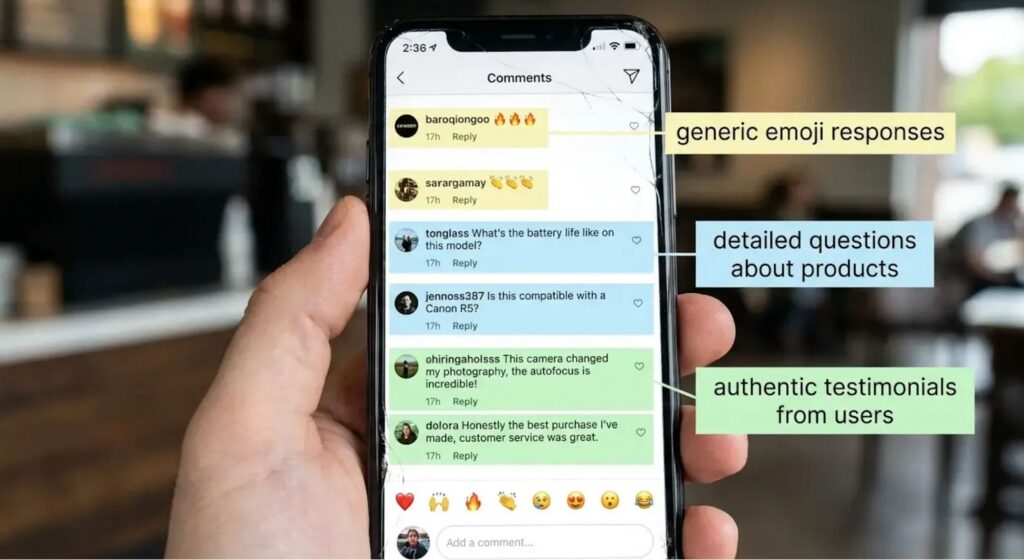
Read the comments on any creator post and patterns emerge quickly. Some are engagement ("Love this!" "So cute!" "😍"). Others are questions ("Where can I buy this?" "What shade is that?" "Does it work for sensitive skin?"). Others are testimonials from audience members who already own the product. These categories carry entirely different commercial signals, and counting them together into a single engagement rate destroys the information they carry.
Questions signal active purchase consideration. Someone asking for product specifications is in an information-gathering phase before a decision. These are your highest-intent audience members, and their presence in a creator's comment section tells you that creator's audience moves toward purchase when they see relevant content. Testimonials from other audience members are even more valuable — when someone who isn't the creator vouches for your product unsolicited in the comment section, that peer validation is more credible than anything the paid post itself could accomplish.
How to Spot Fake Engagement in Comments
Fake engagement has tells. Comments that are generically positive ("Great post!" "Love your content!") without referencing anything specific from the post are frequently from engagement pods or automated activity. Check the accounts leaving comments — if they're disproportionately creators with similar follower counts posting nearly simultaneously, you're looking at coordinated pod behavior rather than organic audience response. Genuine audiences are diverse: varied follower counts, different interests, different posting frequencies.
Also examine comment timing. Fifty comments appearing in the first three minutes after posting is a red flag. Organic engagement distributes across hours and days as different portions of the audience encounter the post through their feeds. SPIRRA's platform applies True Follower™ verification and fraud detection across 19 million creators to surface these manipulation patterns before they reach your campaign. A creator willing to manufacture metrics for their own growth will have no compunction about allowing fraudulent reporting on your campaign.
Questions to Ask About Every Comment Section
When reviewing a creator's recent content as part of partner evaluation, ask these questions systematically:
- Are people asking where to buy? How quickly did the creator respond? Did they make conversion straightforward?
- Are existing customers sharing their own experiences? What is the sentiment? How does the creator engage with both positive and critical responses?
- Are the friend tags contextual ("you need this") or generic ("lol")? Contextual tags indicate the recommendation has social weight and travels off-platform.
- Are there objections or skepticism in the comments? How does the creator handle them? Defensive responses damage trust. Thoughtful engagement with skepticism builds it.
- Are comments about the product or exclusively about the creator? A post where all engagement centers on the creator's appearance rather than the product itself is a post that failed to transfer credibility to the brand.
Comment Analysis Checklist for Campaign Review:
- ☐ Calculate percentage of comments showing purchase intent (questions about where to buy, pricing, availability, specifications)
- ☐ Identify testimonial comments from existing customers and note sentiment
- ☐ Count friend tags and categorize by context (genuine recommendation vs. casual mention)
- ☐ Review creator response rate and quality — did they answer product questions, and how thoroughly?
- ☐ Flag generic or suspiciously timed comments that may indicate pod activity
- ☐ Document specific purchase-intent language ("adding to cart," "just ordered," "need this")
- ☐ Compare comment patterns to the creator's non-sponsored posts to establish an authenticity baseline
The 48-Hour Window: Why Timing Matters More Than You Think
How Instagram's Algorithm Decides Which Posts to Amplify
Instagram makes critical content distribution decisions within the first hours after a post goes live. The algorithm evaluates engagement velocity, time spent on the content, and the quality of interactions — saves and shares carry more weight than likes. If a post performs well in this initial evaluation window, Instagram amplifies it: more followers see it, and it begins appearing in hashtag feeds and the Explore page. If it underperforms in those early hours, the algorithm limits distribution, and the post reaches only a fraction of its potential audience regardless of how it performs later.
This creates a timing problem with direct campaign implications. A creator asked to post at a time when their audience isn't active is effectively being set up for underperformance before a single person has seen the content. The post might be excellent. It might be perfectly aligned with the brand's messaging. Published into a low-engagement window, it fails to earn the early signals that trigger algorithmic support, and the campaign never reaches its potential reach ceiling.
Why Most Brands Get Post Timing Wrong
Brands want all creator posts to go live on the same day — typically a Monday morning, because it looks coordinated in the campaign plan and simplifies reporting windows. This synchronized approach also frequently guarantees that a significant portion of the posts will underperform, because different creators' audiences have different active periods, and forcing uniform timing ignores that reality entirely.
The operational fix requires releasing control that most campaign management structures aren't designed to release. Creators should post when their own analytics tell them their audience is most active. Campaign timing should be staggered across a window of several days rather than synchronized to a single launch date. And when multiple creators in the same niche post about the same brand on the same day, their substantially overlapping audiences encounter a coordinated ad blitz rather than separate genuine recommendations — which is exactly the pattern that triggers maximum skepticism.
The Second Wave: What Happens After the Initial Push
Most brands stop tracking campaign performance after the first week. They collect headline metrics, populate the reporting deck, and move budget to the next initiative. In doing so, they miss a significant portion of the value their campaigns generated.
Posts with high save rates frequently see performance spikes days or weeks after the initial publish date. Someone saved the content, returned to it in a relevant moment, shared it to their story, and introduced it to a new audience that wasn't part of the original organic reach. Holiday and seasonal content in particular can see renewed engagement weeks after posting as audiences enter the consideration window the brand was targeting. Track posts for a minimum of 30 days, and ideally 60 to 90, before closing out performance reporting. The content that looks moderate at day seven often becomes your strongest campaign asset by day 45.
Long-Term Partnerships vs. One-Off Posts: The ROI No One Talks About
Why One-Off Posts Feel Like Ads (Because They Are)
When a creator posts about your product once and never mentions it again, their audience notices the pattern. The recommendation reads as a transaction rather than a genuine endorsement, because genuine endorsements appear repeatedly in different contexts over time. One-off posts are structurally incapable of building trust because trust requires consistency. A single recommendation, regardless of how well-crafted the content is, cannot demonstrate that the creator actually uses the product or genuinely believes in it.
Brands default to one-off posts because they're simpler to budget, contract, and manage than ongoing relationships. You run a campaign with ten creators, collect ten posts, present the reach numbers, and call the program complete. But you've optimized for operational simplicity rather than program effectiveness. The single most reliable structural improvement most instagram influencer marketing programs could make is extending partnership duration from one post to a minimum of three to six months of genuine integration.
How Long-Term Partnerships Change Audience Perception
When a creator mentions a brand multiple times over months, audience perception shifts categorically. The first mention may register as a paid placement. The second establishes a pattern. By the third or fourth reference — especially when those references occur in different content contexts and formats — the audience begins to accept this as a genuine product preference rather than a sponsored obligation.
Repetition builds familiarity, and familiarity transfers authority. Audiences start associating your brand with the creator's credibility in their category. When they encounter your product in other contexts — paid search, a retail shelf, a friend's recommendation — the creator's prior endorsements activate a pre-existing positive association. That upstream influence on conversion is entirely invisible to last-click attribution and almost entirely absent from one-off campaign reporting.Example: A fitness supplement brand structured a six-month partnership with a nutrition coach who had 28K followers in evidence-based dietary guidance. The creator received product monthly and integrated it organically when genuinely relevant to her content. The first mention in month one generated modest engagement and 12 product page visits. By month three, when she referenced the protein powder casually in a meal prep tutorial, the mention drove 89 site visits and 14 purchases. By month six, audience members were asking unprompted which protein powder she used, and her recommendation generated consistent weekly sales without any formally scheduled sponsored content that month. The audience had concluded — correctly — that this was genuinely her preferred product.

The Economics of Long-Term Partnerships Actually Work Better
Long-term partnerships cost less per post than one-off deals. Committing to six or twelve months of creator activity provides the creator income security that justifies a lower per-post rate. A creator charging $3,000 for a single post may structure a twelve-month retainer at $2,000 per post. Twelve posts cost $24,000 versus $36,000 for the same volume of one-off placements — a 33% reduction in cost per content unit, plus the compounding performance benefits of relationship-built audience trust.
Overhead also drops substantially. One contract negotiation. One creative brief alignment. One creator onboarding. One relationship management cadence. Compare this against the administrative load of managing twelve separate one-off relationships across the same budget, each requiring individual negotiation, onboarding, approval cycles, and reporting reconciliation. The efficiency gain from fewer, deeper partnerships compounds alongside the performance improvement.
Long-Term Partnership Contract Template:
Partnership Duration: [3-month trial / 6-month commitment / 12-month commitment]
Content Deliverables:
- [Number] feed posts per [month/quarter]
- [Number] story mentions per [month/quarter]
- Optional: additional organic mentions at creator's discretion
Compensation Structure:
- Base rate per deliverable: $[amount]
- Performance bonus triggers: save rate above [X%]: +$[amount] / click-through rate above [X%]: +$[amount] / documented conversions: $[amount] per conversion
Creative Guidelines:
- Must-include messaging: [specific claims/benefits]
- Prohibited claims: [anything off-limits]
- Approval process: [timeline and stakeholders]
- Creative freedom level: [explicit statement of control the creator maintains]
Product Access:
- Initial shipment: [what's included]
- Ongoing access: [monthly/quarterly replenishment]
- New product previews: [yes/no and timing]
Performance Reporting:
- Creator provides: [specific metrics, frequency]
- Brand provides: [conversion data, campaign feedback, frequency]
- Review cadence: [monthly check-ins, quarterly reviews]
Exit Conditions:
- Either party may terminate with [X days] notice after trial period
- Immediate termination clauses: [specific violations]
- Post-termination obligations: [content handling, non-disparagement]
Niche Communities Are Outperforming Mass Audiences
Why Broad Appeal Is Actually a Liability
A creator with a broad, unfocused audience has a structurally weak audience for brand partnership purposes. Their followers arrived for different reasons, care about different content, and respond to different messages. When they post about your product, only the fraction of their audience interested in that specific category is even receptive. For a general lifestyle creator with 500K followers, you may be paying to reach 500K people when the relevant audience is 80K to 100K.
A creator with 50K followers who posts exclusively about your product category delivers a fundamentally different commercial proposition. All 50K followers are there specifically for content in that space. Every impression the sponsored post earns is an impression on a pre-qualified audience member. The math that makes niche targeting superior is obvious. The barrier is organizational — brands find it easier to report that they reached 500K people than to explain why reaching a more relevant 50K produced better business outcomes. Changing what gets reported in program reviews changes what gets optimized in program design.
How to Find and Evaluate Niche Creators
Finding niche creators requires different discovery strategies than identifying mass-market accounts. General category searches surface the largest accounts. Niche discovery requires looking at category-specific hashtags several levels deep — not #beauty but #exfoliationroutine or #retinolbeginners. Look at who is posting consistently with high specificity and whose content demonstrates genuine expertise rather than trending-topic surfing.
Check comment sections on competitor brand posts and on posts from creators adjacent to your category. Identify which niche creators your existing customer base follows. Your actual buyers are the best signal of which creators their attention trusts. SPIRRA's discovery infrastructure searches across 19 million influencers with 150 verified data points per creator, including audience alignment scoring that surfaces niche creators whose followers match your target customer profile — the variable that generic platform search cannot surface at scale.[spirra]
Niche Doesn't Mean Small (But Small Is Often Right)
Some niche creators have substantial followings because the niche they serve is genuinely large. A creator who posts exclusively about running can accumulate 200K followers from the millions of runners on Instagram. They're still niche because their content is focused, and their audience is there specifically for running-related guidance. But most niche creators have smaller audiences because they serve smaller communities, and that concentration is a feature rather than a limitation for brands targeting those communities.
The conversion math consistently favors qualified reach over aggregate reach. A campaign reaching 50K highly qualified prospects and converting 2% generates 1,000 customers. A campaign reaching 500K mostly unqualified people and converting 0.3% generates 1,500 customers — at ten times the distribution cost. The second campaign produced more nominal conversions, but its economics are worse and its audience quality data provides less actionable intelligence for future allocation decisions.
How to Audit a Creator's Actual Influence (Not Just Their Media Kit)
Media Kits Show What Creators Want You to See
Every creator's media kit looks impressive. Polished design, selectively curated metrics, testimonials from prior brand relationships. Media kits are sales materials. They present the creator's strongest performance windows, exclude underperforming content, and offer audience demographic data from Instagram Insights that becomes directionally unreliable above a certain follower scale.
Past brand partnerships listed in media kits don't tell you results. A creator can demonstrate twenty prior brand relationships without disclosing whether any of those brands were satisfied with performance, renewed the relationship, or saw any business impact from the campaigns. You're seeing a client logo list, not a performance record. Any brand evaluation that stops at media kit review is skipping the data that actually predicts whether the partnership will produce results.
The Audit Process That Actually Reveals Influence
Manually review the last 30 posts on the creator's feed. Calculate average engagement rate yourself using raw numbers — don't accept reported metrics without independent verification. Examine the range, not just the average. Consistent performance across varying content types indicates a genuinely engaged audience. Wild variance with occasional exceptional outliers may indicate artificial amplification of specific posts.
Read comments on recent content, with specific attention to any prior sponsored posts. Are people asking product questions? Are they sharing purchase experiences? Or are comments sparse or generic despite strong engagement rate numbers? The comment section of a creator's prior sponsored content is the most predictive data available for how their audience will respond to your campaign.
Ask for references from prior brand partners and contact them. Ask specifically what worked, what didn't, whether they renewed the relationship, and what they would structure differently. A creator whose prior brand partners all ran single campaigns and didn't renew is a meaningfully different risk profile than one whose clients consistently extend into multi-month partnerships.
Example: During a vetting call, a brand asked a creator with 85K followers about their most successful sponsored partnership. The creator immediately referenced a three-month campaign with a meal kit service, explaining that it performed because the brand allowed her to show the product solving a real problem — weeknight dinner stress with children — rather than requiring glamorous product photography. She pulled up specific posts, showed comment threads where audience members asked detailed follow-up questions she had answered, and shared that the brand renewed for another six months based on their own conversion data. When asked about underperforming content, she described a one-off campaign where the brand provided a rigid script that didn't match her voice. Engagement was half her baseline, comments were sparse. That self-awareness and willingness to discuss failure is the signal. It indicates a creator who is learning and improving rather than one who attributes all performance variance to factors outside their control.
The Questions to Ask Before You Sign
Ask about the creator's audience in their own words — not demographics from a media kit, but their lived understanding of who follows them and why. A creator who can articulate this with precision and specificity knows their community. Vague answers suggest they've never thought carefully about who they're actually reaching.
Ask about their content creation process: how far in advance they plan, how many drafts they typically produce, whether they test different approaches. Ask what they need from brand partners to do their best work. Experienced, thoughtful creators have specific answers to this question — adequate lead time, meaningful creative latitude, clear brief on what success looks like. Creators who respond with "whatever you need" haven't considered what produces good work and are unlikely to proactively solve problems when they arise during the campaign.
Building Creator Relationships That Don't Feel Transactional
Why Most Brand-Creator Relationships Fail
Most brand-creator relationships fail because they start transactional and never evolve beyond that dynamic. The brand treats the creator as a content production vendor. The creator treats the brand as a revenue source. Neither party is invested in making the collaboration genuinely effective, and the content produced in that environment reflects both parties' lack of real investment.
Misaligned expectations are the proximate cause of most partnership failures. Brands expect detailed brief compliance and specific creative execution. Creators expect reasonable latitude and enough context to translate the brief for their specific audience. Neither side articulates these expectations clearly until a conflict forces the conversation, at which point the relationship is already strained.
Creative conflicts compound everything. When brands attempt to control every element of execution, the creator feels undermined. The resulting content is stiff, misaligned with the creator's established voice, and immediately legible to their audience as an external production requirement rather than a genuine recommendation. The brand got what they asked for and produced content that underperforms what the creator would have made with appropriate creative space.
What Creators Actually Want From Brand Partners
Creative freedom is what creators value most and what brands most frequently withhold. Creators have developed their audience's trust through a specific voice, perspective, and content approach. When brands override that approach with prescriptive creative direction, they're not just constraining the creator — they're removing the elements that made the creator's relationship with their audience worth paying for.
Influencer relationship management at its most effective treats creators as partners with specialized expertise about their audience, not vendors delivering a specification. Brands that communicate clear objectives and then trust creators to determine execution consistently produce better content and experience lower revision cycles than brands that provide detailed production requirements.
Clear communication about timeline, approval process, success metrics, and payment terms matters alongside creative freedom. Payment timing in particular is a relationship signal that brands underestimate. Net 60 payment terms communicate that the brand doesn't prioritize the creator's business interests. Brands that pay within 15 days stand out in a market where late payment is common enough to be a significant creator complaint.
How to Build Partnerships That Last Beyond One Campaign
Start with a conversation before a contract. Get on a call with the creator before any negotiation begins. Discuss their audience, your campaign objectives, and whether there's genuine alignment between what you're trying to communicate and what they've built credibility to say. This conversation establishes a human foundation that makes every subsequent interaction more productive.
Be responsive during the campaign. When a creator submits content for approval, review it within 48 hours. When they ask a question, answer within 24 hours. Your responsiveness is a real signal about how much you value the partnership, and creators communicate those signals to their networks. Provide feedback that is specific and actionable rather than directionally vague — not "this doesn't feel right" but "the product mention feels forced here; what if you introduced it as the solution to the problem you set up in the intro?"
Maintain the relationship between active campaign periods. Send new products when you launch them. Share relevant industry news. Check in without an agenda attached. Brands that stay in contact when they're not buying anything signal that they value the relationship rather than just the deliverables. That investment produces creators who genuinely advocate for the brand beyond contracted obligations — and that unpaid advocacy, when it materializes, is the highest-quality signal a brand can generate on any social platform.
The Role of User-Generated Content in a Post-Influencer World
Why UGC Is Outperforming Traditional Influencer Content
User-generated content from customers with 300 followers is outperforming polished content from paid creators in a growing number of performance contexts. Ads built on UGC consistently earn higher click-through rates and lower cost-per-acquisition than equivalent ads built on professional influencer content or brand-produced creative. The reason is intuitive: UGC is unambiguously genuine. A person with a small account sharing content about a product they like has no apparent commercial motive, and audiences apply dramatically less skepticism to the recommendation as a result.
UGC also lacks the aesthetic signals that trigger ad-avoidance behavior. It's shot on phones in natural lighting with imperfect framing. It looks like content people make for themselves, not content produced to serve a brand brief. That aesthetic difference is not a liability to be corrected — it's the source of the format's trust premium. Production quality that reads as professional now works against credibility by confirming the commercial nature of the content.
How to Generate UGC Without Manufacturing It
The most sustainable UGC programs are built on products that people genuinely want to share about. You cannot force organic content creation through incentives without undermining the authenticity that makes UGC valuable in the first place. The structural question is: does your product do something remarkable enough that customers naturally want to document and share it?
Create conditions that make sharing easy and rewarding. Unboxing experiences with visual interest. Packaging that people photograph. Brand handles and hashtags on product materials so customers who want to tag you can do so without friction. Build community spaces — a Facebook group, a Discord, a branded hashtag — where customers who already talk about your category can naturally mention your product. Respond to UGC when it appears. Repost it with credit. Make customers feel that their content is seen and valued, because that recognition encourages more of it from them and from others who observe the interaction.
Using UGC in Paid Campaigns
When strong UGC appears, ask for explicit permission to use it in paid contexts. Most customers are genuinely pleased to be asked. Be transparent about where you'll use it, for how long, and whether you'll edit it. Offer compensation even when they don't request it — a product credit, a discount, or a fair payment signals that you value their contribution rather than simply extracting it.
Test UGC against professional creative in your paid campaigns. In most categories, UGC will outperform. When you confirm that, shift creative budget accordingly. Also consider producing UGC-style content in-house for use in paid contexts when organic UGC volume is insufficient — content shot on phones in natural settings, without brand-production polish, consistently performs better in paid distribution than content that looks expensive to make. The aesthetic of authenticity has commercial value independent of whether the content is technically user-generated or brand-produced to look like it.
What This Means for How You Build Your Program
Instagram influencer marketing isn't dead. It's just not what most brands are treating it as.
The playbook that appeared to work in earlier years has stopped working because audiences got smarter, the algorithm changed how content distributes, disclosure requirements restructured trust dynamics, and the creator economy fragmented into niche communities where relevance matters more than scale. Brands still operating the old model — chasing follower counts, buying one-off posts, measuring success by aggregate engagement rate — are spending budget to generate activity that doesn't translate into business outcomes.
The channel still works for brands willing to operate differently. Smaller budgets distributed across more precisely aligned niche creators. Partnership durations long enough for genuine product integration and audience trust to develop. Creative latitude extended to creators who understand their audience better than any brief can capture. Measurement systems that track save rates, comment sentiment, and share velocity rather than likes and follower-normalized engagement percentages. Attribution models that account for the multi-touch reality of how audience members move from awareness to purchase.
The brands building durable influencer programs right now share one characteristic: they're treating creators as specialized partners with genuine audience expertise rather than as content production vendors in a media buying workflow. That structural shift is not about being kind to creators. It is about recognizing that the mechanism of influence — trust built through consistent, genuine, relevant communication — only operates when the conditions for trust exist. You cannot engineer trust out of a one-off transactional campaign. You can build it through relationships designed for it from the start.
For brands managing programs of any scale, the manual work of running this evaluation across a shortlist of 30 to 50 creators before each campaign cycle is the labor-intensive bottleneck that prevents programs from operating at the quality level the evaluation framework calls for. SPIRRA's platform surfaces this intelligence automatically across 19 million creators — True Follower verification, Brand Alignment Scores, Content Alignment Scores, audience demographic matching against your target customer profile, and brand safety monitoring that runs continuously rather than only at the point of initial vetting.
Finding influencers on Instagram with enough confidence to commit real budget requires verified data on all of these variables, not a follower count and a media kit. The brands generating consistent, compounding returns from instagram influencer marketing are the ones who made the shift from reach-based selection to alignment-based selection — and who built the measurement infrastructure to know the difference. If your current program is still optimizing for impressions from accounts you've vetted with a spreadsheet, request a demo to see what program design looks like with verified audience intelligence behind every decision.