
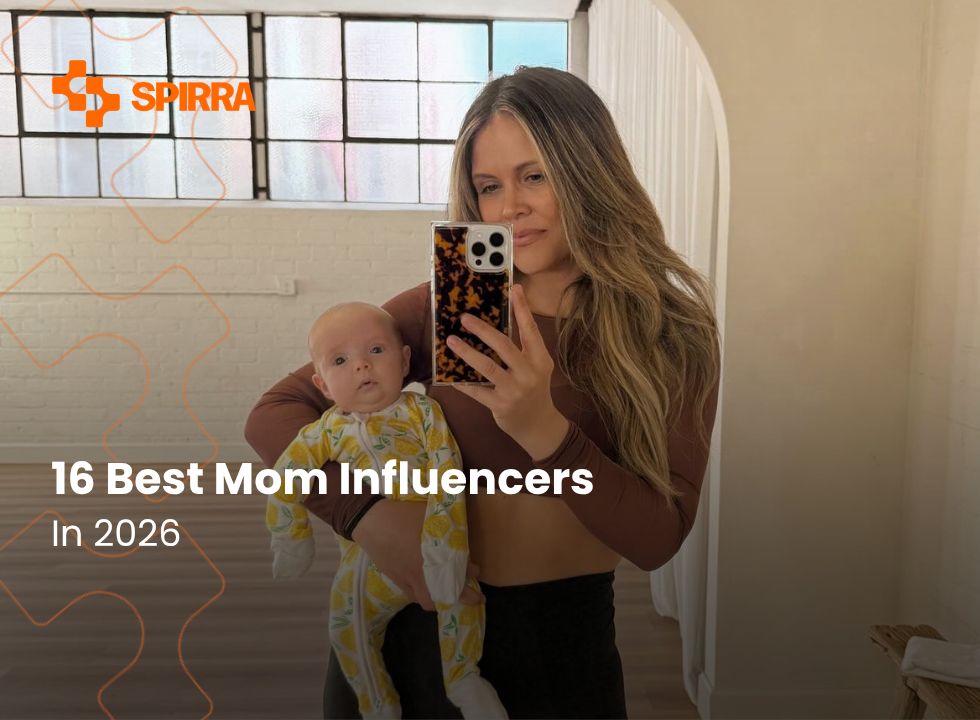
Most mom influencer roundups feature the same familiar names, ranked by follower count. This one looks at something different: the operational choices behind the content, how these creators structure partnerships, diversify revenue, and build teams that let them keep producing consistently rather than burning out after one viral moment.
Mom influencers make up a genuinely large and commercially active corner of the creator economy. More than 4.2 million people pursue some form of mom-influencer work, and these creators mention brands in their content an average of 73 times a week, according to research from Vocast. That volume of commercial activity means the creators who last, rather than burning out after a single viral moment, tend to be the ones running something closer to an actual small business than a casual hobby account. Understanding what makes influencer partnerships authentic requires looking past follower counts entirely and toward how a creator actually operates: what they'll partner with, how selective they are, and what happens behind the account when the camera's off.
Every creator in this piece is currently active and posting, and every profile centers on someone whose content is genuinely built around motherhood and family life, not a creator in an unrelated niche who happens to be a parent, or a name that's aged out of relevance. This list is built for brands actively evaluating campaign partners, not a nostalgia tour through influencer history. The 16 creators below span four different approaches: faith-driven creators who use belief as a genuine partnership filter, humor-first accounts balancing comedy with monetization, fitness specialists navigating real liability and messaging considerations, and creators who've built multi-channel businesses that treat Instagram as one channel among several rather than the whole operation.
Faith-Driven Voices
For this group of creators, faith isn't just a content theme; it functions as a genuine business filter. These creators tend to vet potential partnerships against theological and values alignment before considering reach or rate, which generally means a smaller addressable audience for any single partnership, but often a more durable, higher-trust relationship with the people who do follow them.
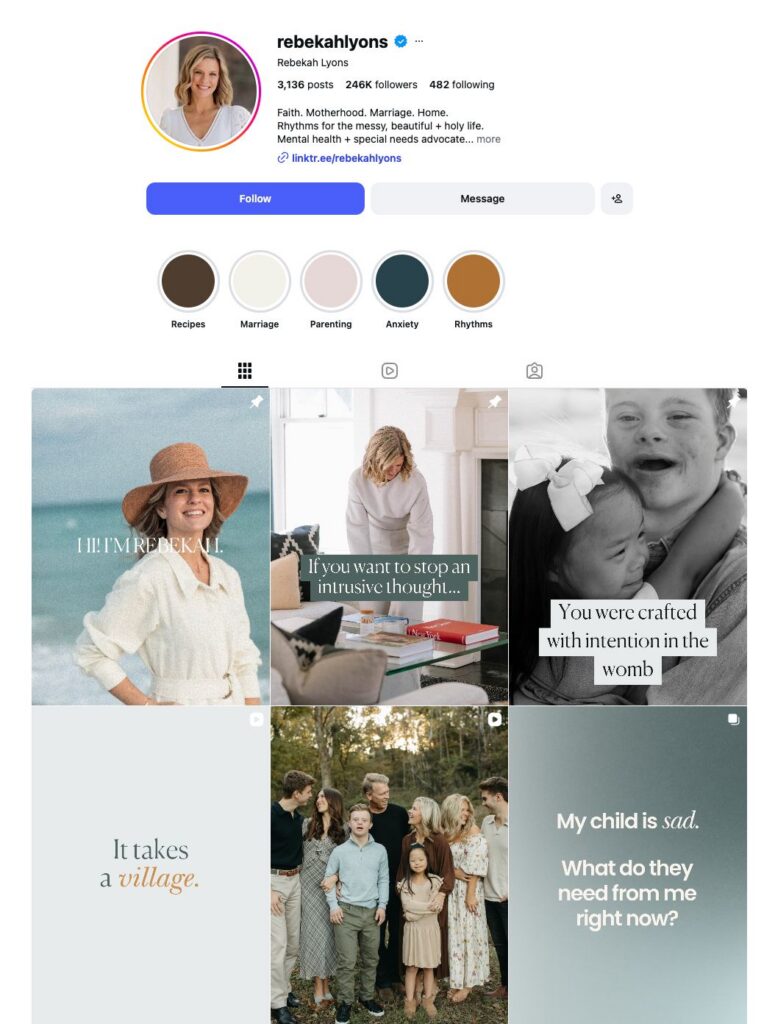
1. Rebekah Lyons
Rebekah Lyons built her platform around anxiety, mental health, and faith, writing books including Rhythms of Renewal and continuing to release new podcast episodes and speak regularly at faith-based conferences and events into 2026. Her content and partnerships tend to cluster around wellness, publishing, and Christian community spaces, reflecting a fairly specific niche positioning: Christian mental health specifically, rather than faith or wellness content broadly. That kind of focused positioning tends to support premium partnership rates on a smaller number of collaborations rather than high-volume, lower-value deal flow. You can find her on Instagram, where her content tends toward longer, reflective captions rather than fast-paced short-form video, consistent with an audience that engages with depth over speed.
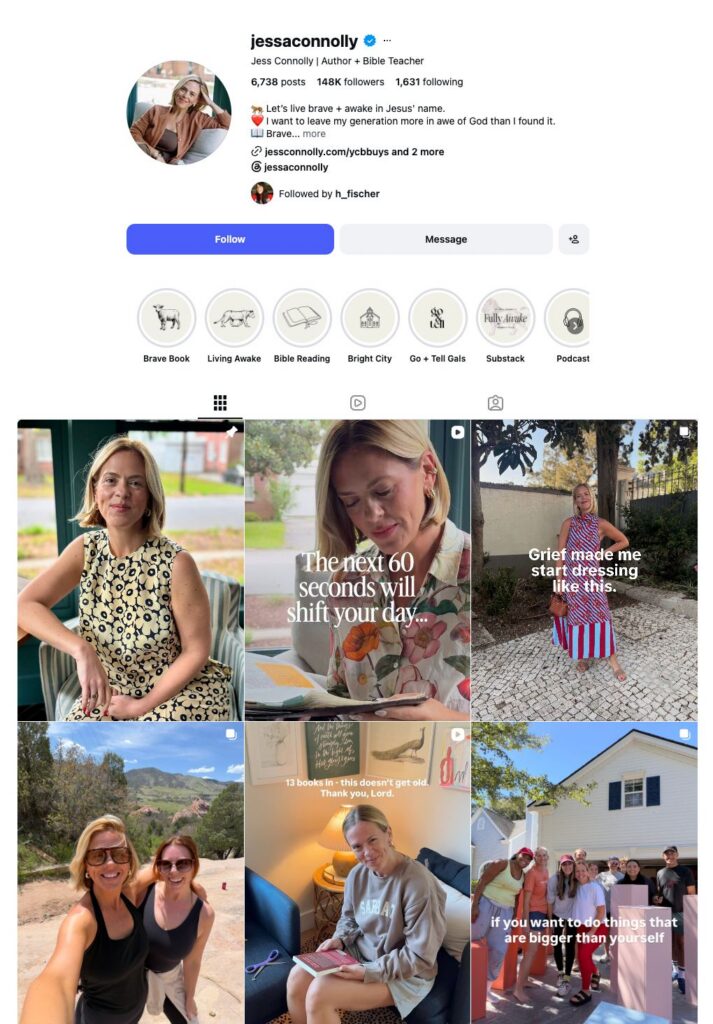
2. Jess Connolly
Jess Connolly, a wife, mother of four, and church leader, built her platform as a faith-centered author, Bible teacher, and podcaster before launching Go + Tell, an apparel brand built around faith-forward messaging that now represents a meaningful part of her broader creative and business work. Running an owned product line changes the calculus around brand partnerships in a specific way: a creator selling her own merchandise has a direct incentive to be more selective about partnerships in overlapping categories, since a competing product mention can cut into her own sales rather than simply supplementing her income. Her content spans faith, motherhood, and product storytelling, and she's active on Instagram, where her own brand tends to take priority in her content mix.
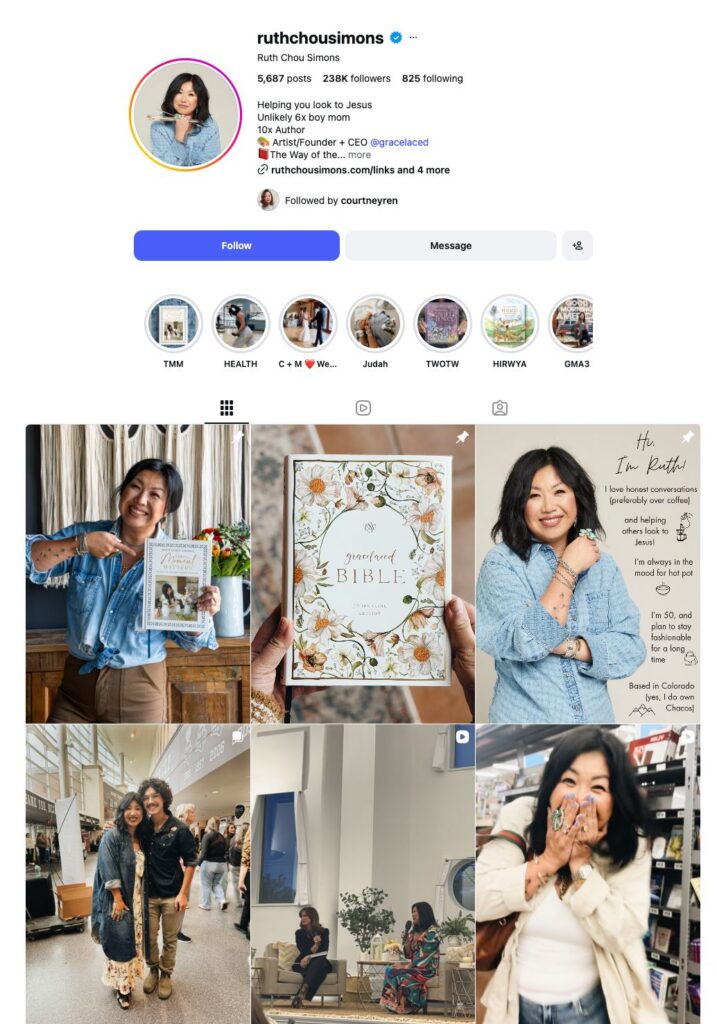
3. Ruth Chou Simons
Ruth Chou Simons runs her platform with a visual-first strategy built around her own watercolor illustration and hand-lettering work, giving her a real structural advantage most creators don't have: she produces her own original visual assets rather than relying on stock photography or third-party design work. She and her husband, Troy, are raising six sons, and family life is woven authentically through her content rather than treated as a secondary theme. That matters for partnerships specifically because brands working with her get genuinely original artwork, not a templated post, which supports premium pricing relative to creators with a similar following size but no distinct visual craft of their own. She's authored several bestselling books, including GraceLaced and Beholding and Becoming, and has expanded into a stationery and lifestyle product line that grew directly out of audience demand she saw on Instagram. Scripture and faith themes run through her illustration work as a consistent aesthetic and message rather than functioning as a strict partnership filter, which tends to widen the range of brands she can reasonably work with compared to a more doctrinally restrictive positioning.
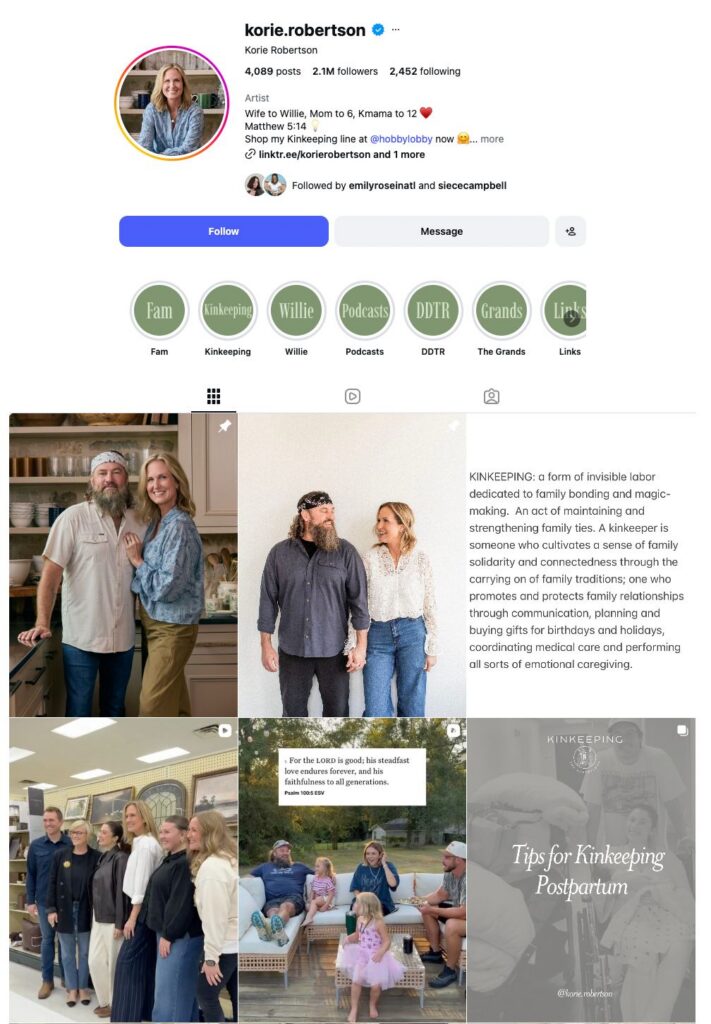
4. Korie Robertson
Korie Robertson, known to most audiences from A&E's Duck Dynasty and its 2025 follow-up Duck Dynasty: The Revival, has spent more than a decade building a media and product business alongside her husband, Willie, that extends well beyond the original show. She's a New York Times bestselling author of several faith-and-family books, including Strong and Kind: Raising Kids of Character and The Women of Duck Commander, and she serves as office manager of Duck Commander, the family's outdoor gear company, alongside her own separate ventures.
Her operational range is genuinely instructive for brands evaluating a faith-based creator with real commercial scale: in September 2026, she launched Kinkeeping, an exclusive home decor collection with Hobby Lobby that rolled out across more than 1,000 stores nationwide, following more than a year of collaborative product development. Just two months earlier, she and Willie launched EKKL Entertainment, a faith-and-family streaming platform offering movies, podcasts, and daily devotionals, a direct response to what she's described as a gap in trustworthy family content. That combination, a nationally distributed retail licensing deal and a self-owned media platform launched within the same year, shows a creator treating her audience as the foundation for multiple, genuinely diversified business lines rather than a single content stream. She posts to Instagram, where family life, faith, and her various ventures are woven together as a consistent, ongoing narrative.
Humor First, Chaos Always
Comedy content operates under different constraints than the categories above it. Jokes and memes have a genuinely short shelf life, humor-based creators typically need faster production cycles and more frequent posting, and brand integrations require real care, since an audience tends to notice quickly when a joke gets bent to accommodate a sponsor. Authenticity concerns are heightened specifically because comedy audiences are primed to spot when something feels like it's "selling out," and that skepticism can hit engagement faster than it would for a more straightforwardly promotional account.
| Content Type | Typical Shelf Life | Brand Integration Challenge |
| Comedy and memes | 24-72 hours | Must maintain humor while promoting |
| Faith content | Largely evergreen | Theological alignment required |
| Fitness tutorials | Roughly 3-6 months | Liability and safety disclaimers |
| Business or educational content | Roughly 6-12 months | Establishing authority takes time |
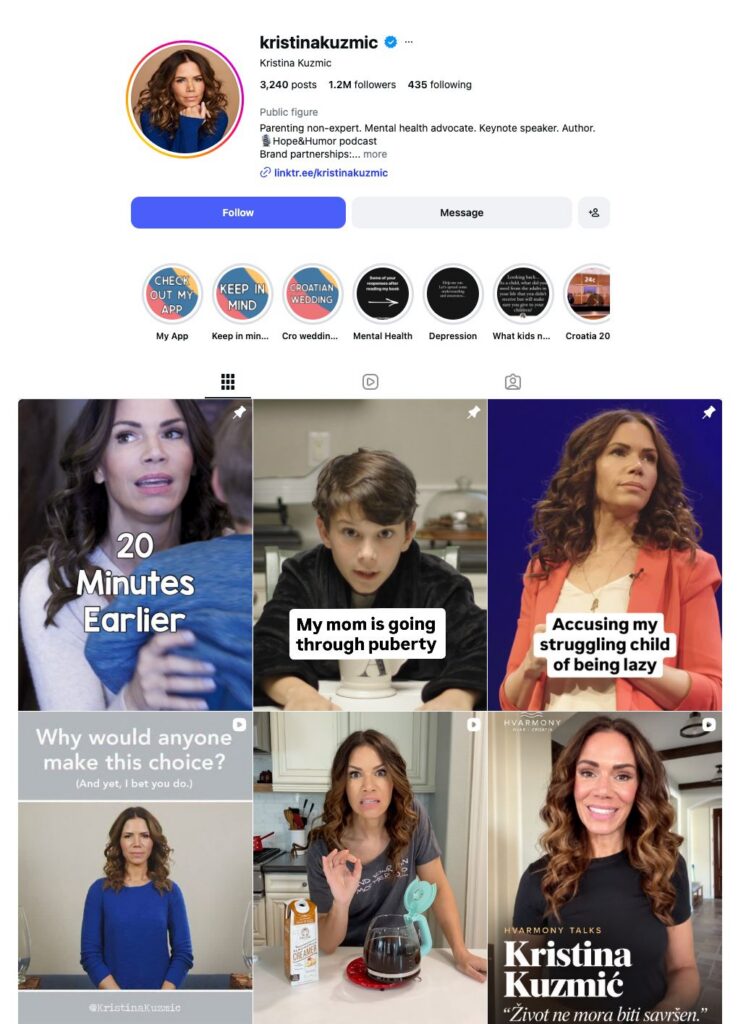
5. Kristina Kuzmic
Kristina Kuzmic built her platform on candid, often funny, self-deprecating content about the chaos of parenting, and has since expanded into a genuine multi-platform presence spanning Instagram, YouTube, and public speaking. Her comedic style leans into relatable, mass-market household moments rather than aspirational lifestyle content, which naturally steers her partnerships toward everyday consumer products where humor supports rather than undercuts the brand message. She's also written candidly about far more serious material, including a 2024 memoir describing her family's experience with her teenage son's struggle with depression and drug use, a meaningful departure from her comedic content that reflects the same underlying commitment to honesty that built her audience in the first place. Roughly 60% of mom influencers say they only talk about brands they genuinely love, per Vocast's research, a pattern consistent with the authenticity-first approach that's core to Kuzmic's appeal.
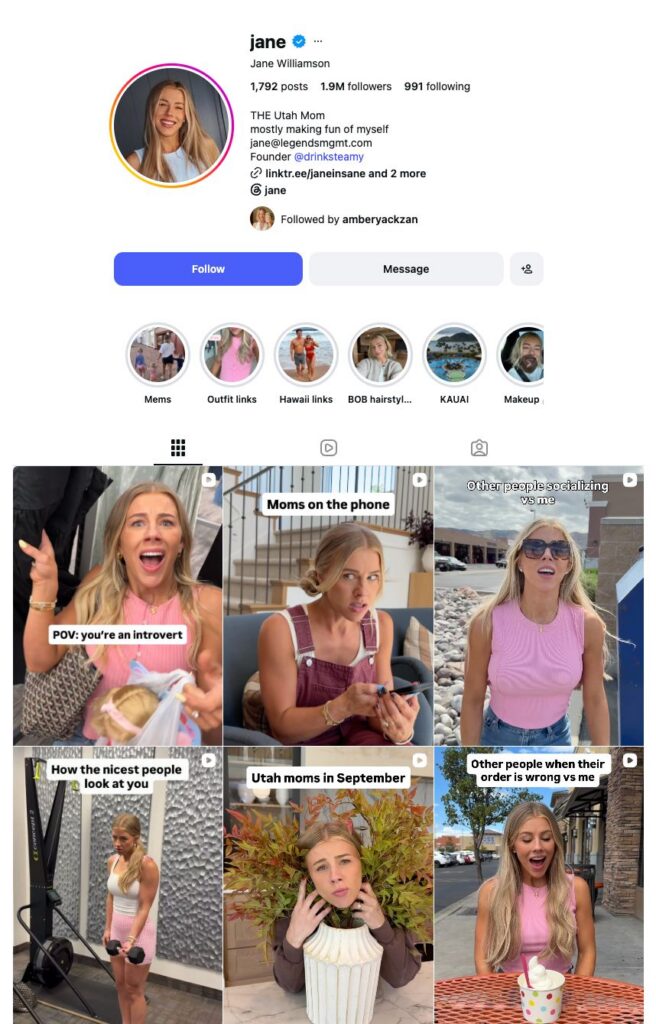
6. Jane Williamson
Jane Williamson, who posts as @jane and built her earlier following under the handle @janeinsane_, is known online as "THE Utah Mom," building a following of nearly 2 million on Instagram and several million more across TikTok and YouTube through satirical skits about motherhood, Utah mom culture, and the chaos of raising kids. Her comedy works specifically because it's rooted in genuine self-deprecation rather than distance from her subject; she's a mother making fun of her own daily reality, not an outside observer mocking a group she doesn't belong to, which is a meaningfully different trust proposition for brands than pure parody content.
She's also built an owned product line, Drink Steamy, alongside her content work, giving her a revenue stream that doesn't depend entirely on brand sponsorships. Her recent engagement rates have run well above typical platform benchmarks, and her content mix blends comedic skits with more conventional vlogging and brand collaborations, a combination that lets her take on a wider range of partnerships than a pure-parody account could sustain.
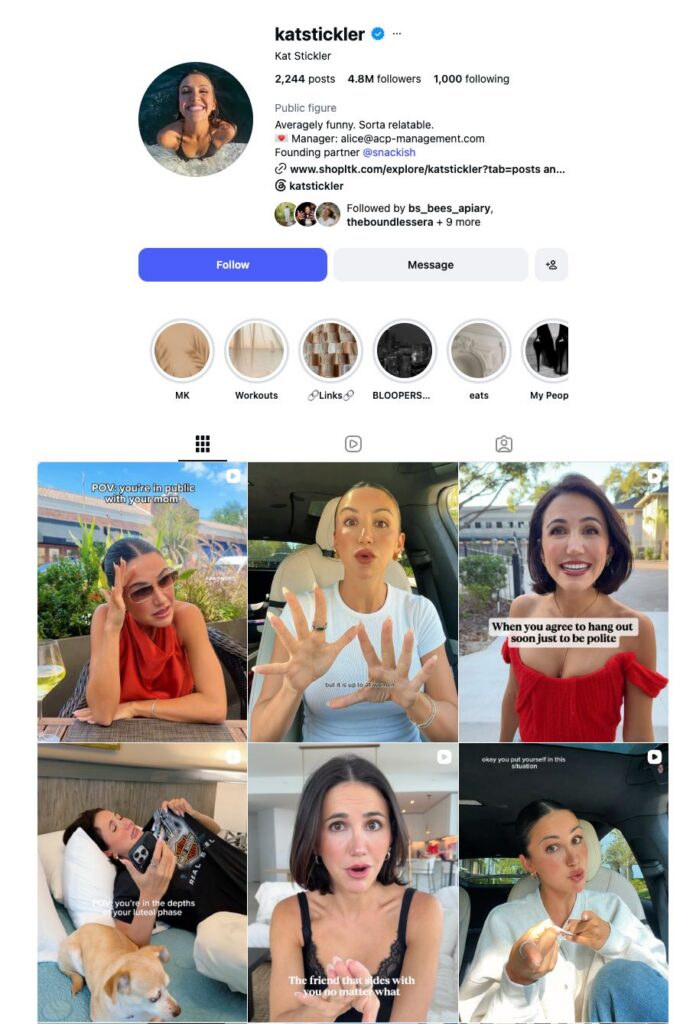
7. Kat Stickler
Kat Stickler built her original audience on TikTok during the pandemic through comedic family content with her then-husband, Mike, and has continued growing a large, currently active following, nearly 5 million on Instagram, following their 2021 divorce and her transition to a solo comedic voice centered on her daughter, MK, and her own dating life. That transition is itself a genuinely instructive operational story: when the couple split, their combined online business, worth millions of followers, had to be divided like any other shared asset, with Stickler retaining the TikTok account she'd helped build and successfully rebranding it around her individual voice, while the couple's YouTube channel saw far less continued activity under her ex-husband.
She's since built Snackish, her own food product line, as a founding partner, giving her a direct product business alongside her content work. Her comedic content coexists with real candor about her personal life, including her public relationships since the divorce, a combination that's kept her relevant across several years of a fast-moving platform, though brands considering a partnership should factor in that her content mix skews toward her personal dating life at times as much as pure parenting comedy.
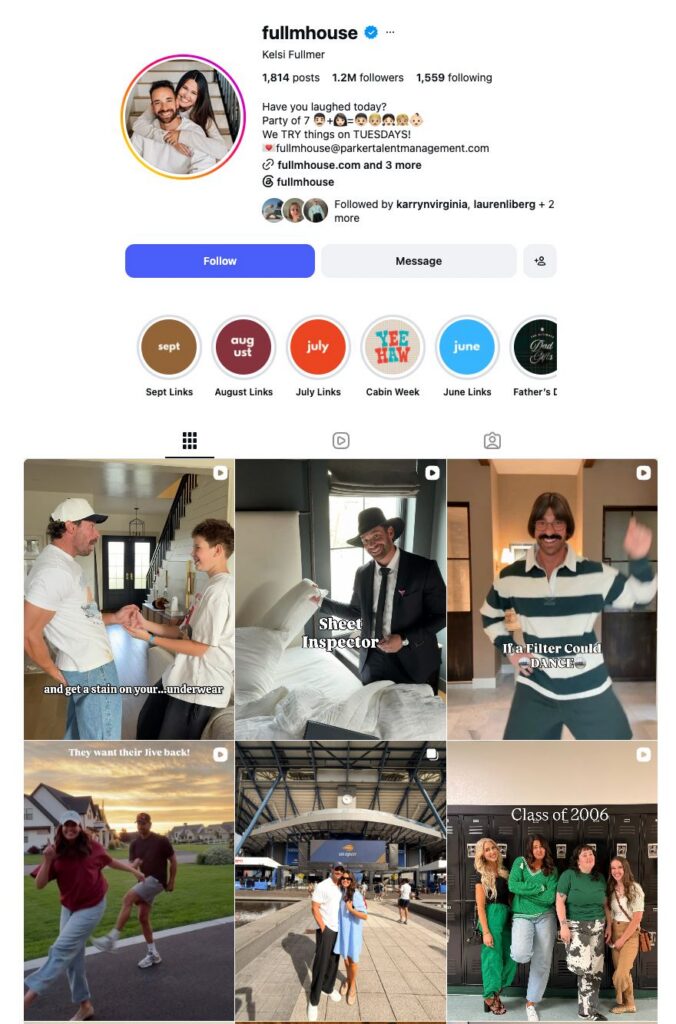
8. Kelsi Fullmer
Kelsi Fullmer runs Fullmhouse with her husband, Caleb, documenting their family's daily life in Rexburg, Idaho, through a mix of comedic skits, home and lifestyle content, and gift-guide-style product recommendations. What started as an occasional side project years ago grew substantially once the couple began posting more consistently, and the account has since become a go-to example of family-comedy content that converts directly into product recommendations, seasonal gift guides, and storefront links that make brand partnerships a natural extension of the content rather than an interruption to it.
Her content spans household products, beauty, fashion, and family-oriented brands, and the account's format, blending humor with genuine, practical recommendations, has built the kind of trust that makes her a frequently sought partner across several product categories at once. It's worth noting that family-vlog content involving young children, the format she and Caleb built their following on, has drawn some public criticism around how much of children's daily life gets shared online, a consideration worth factoring into any brand's broader risk assessment regardless of which family-content creator is involved.
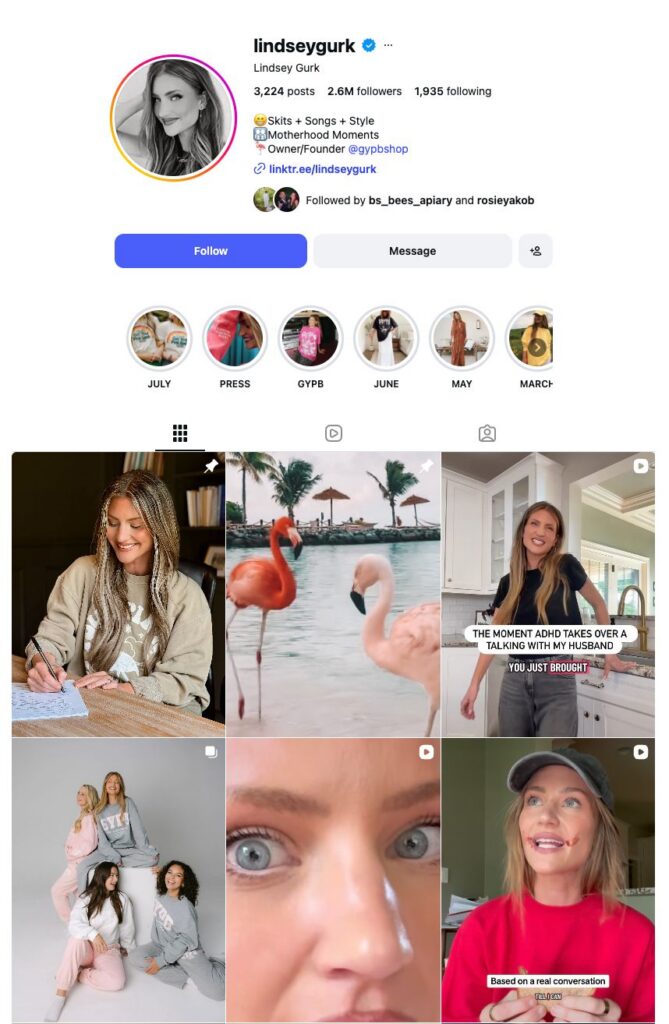
10. Lindsey Gurk
Lindsey Gurk built her platform around a hybrid format she describes as "skits, songs, and style," blending comedic sketches about the specific absurdities of motherhood with more personal, reflective content and an ongoing thread of humor and honesty about the messier parts of parenting. Her Instagram following has grown past 3 million, and her content leans into a recognizable tension many parenting creators lean on: motherhood as simultaneously a genuine blessing and a source of daily, absurd frustration, delivered with a musical or performative twist that distinguishes her from straightforward talking-head comedy accounts.
She also owns and operates GYPB Shop, a product line she's built alongside her content, giving her direct commerce revenue that doesn't rely entirely on brand deal flow. Her partnership history spans a meaningful cross-section of family, lifestyle, and parenting product categories, and she's signed with a major publisher for a forthcoming book project drawing on her viral motherhood content, a sign that her content strategy, like several other creators in this list, is increasingly designed to feed into owned media products rather than staying purely social-platform-dependent.
Strength and Sweat
Fitness content carries operational demands the other categories above don't: it requires actual demonstration, which makes video production close to non-negotiable, and it carries real liability considerations around exercise instruction that make insurance and, in some cases, professional consultation genuinely necessary rather than optional. Messaging around body image also requires real care, since content in this space can either reinforce or push back against unrealistic transformation narratives, and brand partnerships here are heavily weighted toward supplement and apparel categories, both of which carry specific FTC disclosure requirements worth taking seriously.
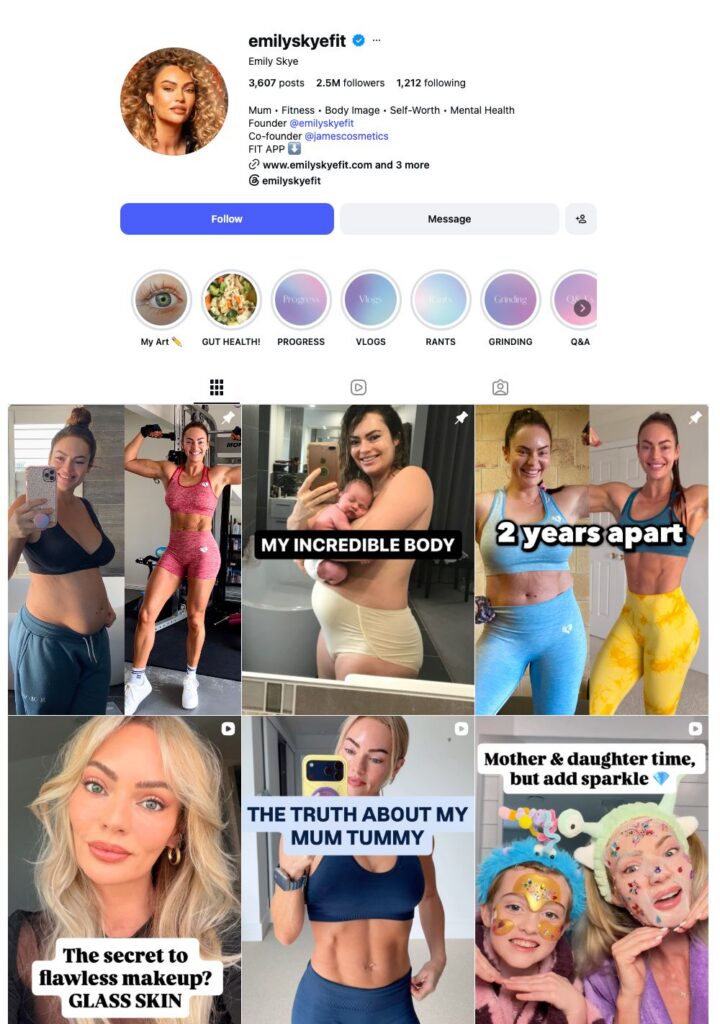
11. Emily Skye
Emily Skye built an early following through sponsored fitness content before launching her own subscription fitness app, Emily Skye FIT, a genuine shift from a partnership-dependent creator model to something closer to a software business. That transition changes what her Instagram content is actually for: rather than driving direct partnership revenue post by post, her content increasingly serves to demonstrate app quality and drive subscriptions, a fundamentally different funnel than a typical sponsored-post model. Building and maintaining an app requires meaningfully more infrastructure than content creation alone, developers, customer support, in-app content production, which makes her operation function closer to a small fitness-tech company than a traditional solo creator account. She's active on Instagram.
12. Katie Crewe
Katie Crewe specializes in prenatal and postpartum fitness content, a niche that carries genuinely higher production and liability overhead than general fitness content. Prenatal and postpartum exercise modifications differ significantly by trimester and recovery stage, which means thorough, medically responsible content in this space typically requires more filming variations and more careful disclaimer language than standard fitness content. Brand partnerships in this specific niche also carry real additional scrutiny, since supplement and product safety considerations for pregnant and postpartum audiences are meaningfully different from general fitness audiences, and a responsible creator in this space has real reason to be selective about which products she's willing to associate with her platform. She posts on Instagram.
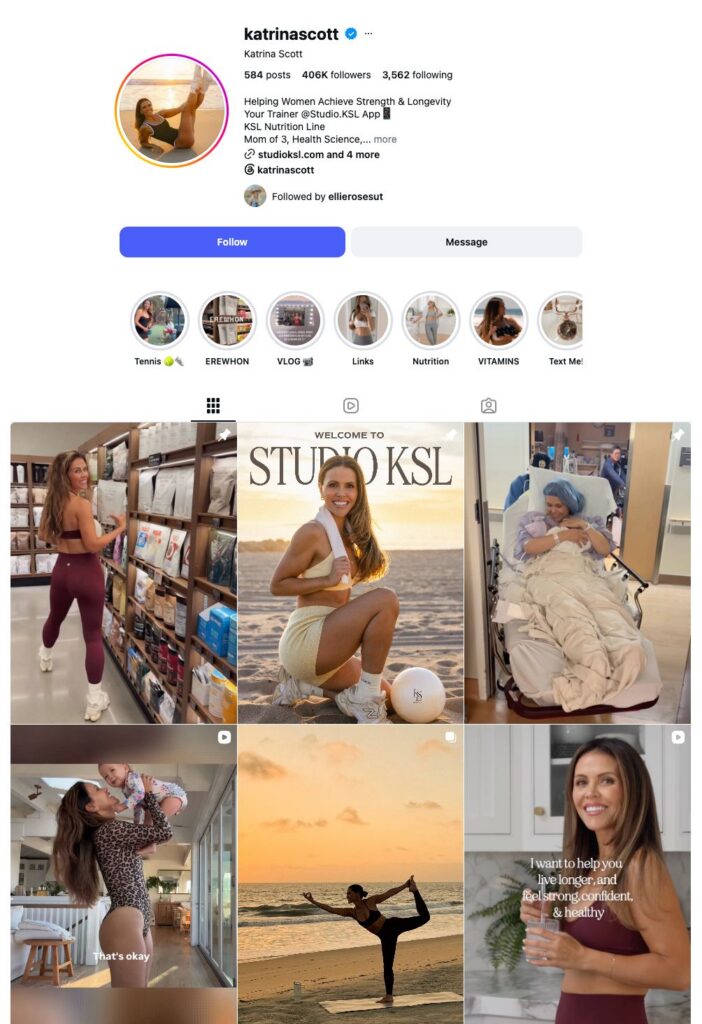
13. Katrina Scott
Katrina Scott co-founded Tone It Up with Karena Dawn in 2009, building it into one of the best-known women's fitness communities, complete with an app, nutrition products, and a large, loyal following. It's worth being current here, since the brand's ownership has changed hands more than once: Tengram Capital Partners acquired a stake in Tone It Up in 2018, the company was later acquired by GoSaga in early 2025, and in December 2025, Karena Dawn reacquired the brand as its sole owner and CEO. That means Scott's current relationship to the brand she co-founded looks different today than it did during Tone It Up's earlier growth years, a genuinely instructive example of how co-founded influencer brands can evolve, and sometimes separate from one or both original founders, as ownership structures shift over time. Scott continues to post to her own Instagram account, maintaining an individual platform distinct from the Tone It Up brand itself.
14. Jessamyn Stanley
Jessamyn Stanley built her platform around body-positive yoga instruction, deliberately rejecting the transformation-focused, before-and-after framing that dominates a lot of fitness content. In 2019, she co-founded The Underbelly with Mary Carr, a digital yoga and wellness app built around inclusive, accessible practice rather than weight-loss messaging, and she's continued building out the platform, including live touring events. That positioning genuinely limits certain partnership categories, weight-loss brands and transformation-challenge campaigns don't fit her stated values, but it also supports a specific, loyal audience relationship: readers and viewers who've felt alienated by more conventional fitness or lifestyle content often describe finding a welcome contrast in creators like Stanley. As one mother wrote in a May 2021 Deseret News essay reflecting on the broader culture of polished mom-influencer content, watching lifestyle accounts with spotless homes and effortless-seeming lives during her own postpartum period left her feeling "ridiculous and defective," a sentiment that speaks to why counter-narrative creators like Stanley resonate with a real segment of the audience. She's also the author of Every Body Yoga and Yoke: My Yoga of Self-Acceptance, and posts on Instagram.
Building Empires, Not Just Feeds
This final group treats their social platforms as one channel within a larger, multi-revenue business, rather than as the business itself. Team structures here tend to resemble small companies rather than solo creator operations, and content strategy is generally built to serve broader business objectives, books, courses, product lines, rather than optimizing purely for engagement.
15. Rachel Hollis
Rachel Hollis built a substantial media and events business, including bestselling books like Girl, Wash Your Face, a large-scale conference series, and a broader lifestyle brand, before facing significant public backlash in 2020 and 2021. The controversy centered on a series of incidents widely covered by outlets including The New York Times and Business Insider: a viral TikTok in which she compared herself to figures like Harriet Tubman and Oprah Winfrey while discussing her own privilege, a prior incident involving an uncredited Maya Angelou quote, and broader criticism of how she discussed wealth and privilege with her team. She lost an estimated 100,000 to 200,000 Instagram followers in the aftermath, according to contemporaneous reporting, and postponed a planned conference as the backlash unfolded. She also announced her divorce from Dave Hollis, her husband and business partner, in June 2020, amid the same period of public scrutiny. It's a genuinely instructive example of concentration risk in a creator-led business: when a significant share of revenue and brand equity is tied directly to one person's public reputation, a single controversy can affect far more than just that one post or campaign. Hollis has continued publishing and podcasting since, operating at a different scale than during the brand's earlier peak years.
16. Kristin Gallant & Deena Margolin
Kristin Gallant, a parent coach with a background in maternal and child education, and Deena Margolin, a licensed marriage and family therapist who studied under Dr. Dan Siegel, met in high school and co-founded Big Little Feelings in March 2020, right as pandemic lockdowns left parents home with restless toddlers and nowhere to turn for practical advice. Both are mothers of three, and their content, quick, scriptable strategies for tantrums, bedtime battles, and sibling conflict, translates their combined clinical and coaching backgrounds into a format busy parents can actually use.
The operational model here is genuinely instructive: their Instagram account, which has grown past 3.5 million followers, functions primarily as a funnel into a much more durable revenue base, paid online courses including Winning the Toddler Stage and Potty Training Made Simple, which have together reached more than 500,000 families, plus a chart-topping podcast that relaunched with Dear Media in mid-2025. That structure, community-building content driving toward owned, recurring-revenue products, insulates their business from any single platform's algorithm changes far more effectively than an account dependent purely on sponsored posts. Their brand partnerships tend to concentrate in educational products, child development tools, and family wellness categories that align directly with their clinical positioning, rather than general lifestyle sponsorships.
17. Eva Chen
Eva Chen worked as a fashion magazine editor, including as Editor-in-Chief of Lucky, before joining Instagram, where she currently serves as Vice President of Fashion Partnerships. That professional role gives her a genuinely distinct position compared to most influencers profiled here: she's a full-time Instagram employee whose personal account, @evachen212, blends personal content, fashion industry access, and real parenting content in a way that reflects both her professional expertise and her life as a mother of three. She's also written children's books drawing directly on her parenting experience, and has spoken publicly, including on Motherly's podcast and with Katie Couric, about balancing a demanding industry role with raising young kids. Her industry credentials and role provide a level of access to fashion shows, launches, and industry relationships that most independent creators would need years to build on their own, which changes both the opportunities and the potential conflicts of interest she has to navigate compared to a fully independent creator without an employer relationship to account for.
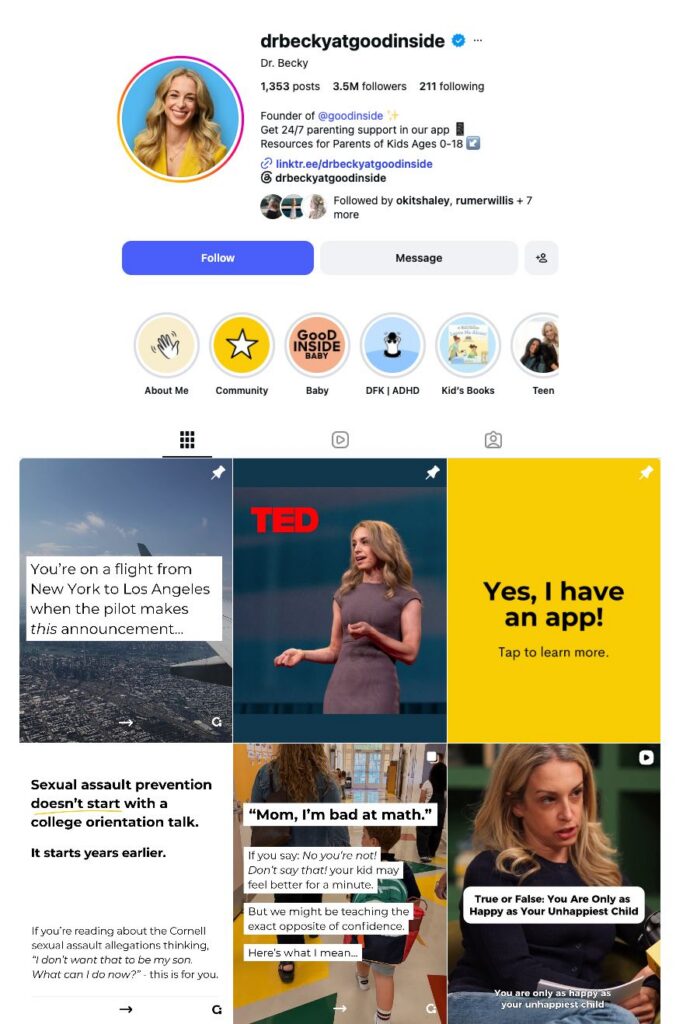
18. Dr. Becky Kennedy
Becky Kennedy, a clinical psychologist and mother of three, launched an Instagram account in 2020 as the COVID-19 pandemic trapped parents at home with restless kids, sharing the parenting concepts she'd developed through years of private practice in Manhattan. Within months, that following turned into an actual company: Good Inside, now a membership-based parenting platform with an app, a podcast, and a bestselling book, Good Inside, that debuted at number one on the New York Times bestseller list.
Her growth trajectory is a genuinely instructive example of how a single, consistent piece of expertise, evidence-based parenting concepts delivered directly to camera, can scale into a real business rather than staying a content hobby. Good Inside now employs more than a dozen people, has grown to more than $34 million in annual revenue as of early 2026, and recently announced a brand partnership with Carter's on a children's confidence-focused initiative. Kennedy's Instagram following has grown to roughly 3.5 million, and her content remains focused specifically on practical, in-the-moment parenting guidance rather than lifestyle content, a specialization that's made her brand partnerships and business relationships closely tied to parenting and child development categories specifically.
Finding Mom Influencers Who Match Your Brand (Not Just Your Budget)
After seeing the real range of operational differences across faith-driven creators, comedy accounts, fitness specialists, and creators running full multi-channel businesses, it's probably clear that follower count alone tells you very little about whether a partnership will actually work. You need a sense of what a creator will and won't do, how selective they are about partnerships, and whether their audience and values genuinely match your brand before reaching out.
Most brands spend real time scrolling profiles, checking surface-level engagement rates, and sending cold outreach that goes nowhere because they're guessing at fit rather than actually verifying it. Whether you're trying to reach a specific faith-based audience, a fitness niche with real safety and messaging considerations, or a creator running her own product line who's genuinely selective about competing partnerships, that kind of fit matters more than raw reach. SPIRRA helps brands move beyond basic metrics by applying strategic influencer identification frameworks that account for audience alignment and brand fit, not just follower counts and engagement percentages.
Frequently Asked Questions
How do I find mom influencers who fit my niche brand?
Start with hashtag research specific to your actual niche, rather than broad tags like #momlife, which surface volume rather than relevance. Look at who your target customers already follow and genuinely engage with, and check comments on larger mom-influencer posts to find smaller, engaged creators already active in your specific space. Prioritize creators who show clear operational consistency: a regular posting schedule, professional responses to inquiries, and a clear rate card or media kit, since that kind of consistency tends to predict a smoother partnership than a creator without any of it. Platforms like SPIRRA's AI-powered influencer discovery can reduce a lot of this manual hashtag scrolling by surfacing creators based on genuine audience alignment rather than keyword matching alone.
What's the difference between working with mom influencers on Instagram versus TikTok?
Instagram tends to favor more polished content with a longer shelf life, and partnerships there typically include more deliverables across formats, Stories, Reels, and feed posts, in a single collaboration. TikTok generally demands faster content velocity and genuine trend participation, and while TikTok creators in this space often post higher engagement rates, that content also tends to have a shorter useful lifespan than an equivalent Instagram post. Instagram-based mom influencers tend to skew toward an older, higher-income audience, while TikTok-based creators in this space often reach a younger, more Gen Z and younger-millennial audience. Production expectations differ accordingly: Instagram content generally calls for higher production polish, while TikTok tends to reward a more authentic, less produced feel.
How much should I budget for mom influencer partnerships?
Rates vary considerably by follower tier, niche, and deliverables, but rough industry benchmarks put micro creators (roughly 5,000-50,000 followers) around 100-500 per post, mid-tier creators (50,000-250,000 followers) around 500-2,500 per post, and macro creators (250,000 followers to 1 million) at $2,500 and up per post. Creators who run their own product lines or apps sometimes decline traditional brand partnerships altogether, or price them at a premium, since a standard partnership has to compete with their own owned revenue. Video content, including Reels and TikToks, typically costs meaningfully more than a static post, and usage rights or exclusivity clauses generally add a substantial premium on top of a base rate.
What makes the best mom influencers different from average creators?
A consistent posting schedule that reflects genuine operational discipline, rather than sporadic bursts of activity, is one of the clearer signals. Professional communication and a clear, transparent partnership process, including an actual rate card, tend to separate creators running a real business from those treating content as a side hobby. Engagement that goes beyond simple likes, genuine saves, shares, and substantive comment conversations, is a better predictor of real audience trust than raw like counts. Revenue diversification beyond brand partnerships alone, and a track record of past collaborations with results a brand can actually verify, both tend to distinguish more established, reliable creators from newer or less consistent accounts.
Can I work with mom and daughter influencers for family-focused brands?
Mom and daughter creator teams can offer genuine cross-generational appeal, often reaching both a millennial mom audience and a Gen Z audience simultaneously through a single piece of content. Partnership logistics get somewhat more complex, since you're coordinating two people's schedules and creative input rather than one, and rates typically reflect the combined reach of both creators without necessarily doubling a single creator's standard rate. Brand fit has to genuinely work for both personalities and both audience segments, which narrows the pool of brands that make sense for this kind of partnership, but fashion, beauty, and lifestyle brands targeting a wide age range tend to be a natural fit for this format.
Final Thoughts
The real story behind the mom influencers who build lasting careers isn't really about authenticity or relatability in the abstract; nearly every creator in this space claims both. It's about the actual operational choices underneath the content: how selective a creator is about partnerships, whether their content strategy serves a broader business goal or just chases engagement, and whether they've built anything durable enough to survive a platform change, an algorithm shift, or, as Rachel Hollis's experience shows plainly, a public controversy that a single-person brand has to absorb without a diversified structure to fall back on.
When you're evaluating a mom influencer for a partnership, you're not just reaching out to a person with a camera and a following. You're engaging with an operation that has real constraints, priorities, and partnership criteria that may or may not line up with what you actually need. The creators who succeed well beyond a single viral moment tend to be the ones who've built something that scales sustainably, whether that's a product line, a publishing career, a subscription app, or a genuine area of expertise like the ones Kristin Gallant, Deena Margolin, and Dr. Becky Kennedy have each built, rather than relying purely on content momentum alone. Understanding long-term influencer relationship management means recognizing that you're partnering with real, ongoing businesses, not just individual creators posting in isolation.
Ready to find mom influencers whose values and operations genuinely match your brand? Schedule a demo with SPIRRA to see how AI-powered alignment scoring helps you evaluate creator fit beyond follower counts.